
 A Oneindia Venture


 Click it and Unblock the Notifications
Notes to Accounts of Meera Industries Ltd.
Mar 31, 2025
2. There is no intent to sell any of the assets held by the company and hence there is no fixed assets held for disposal.
3. During the year, there is no change in amount of the Property, Plant and Equipment due to business combination, revaluation and other adjustments.
4. During the year, the company has not held any benami property as defined under the Benami Transactions (prohibition) Act, 1988.
5. Buildings include the building used for in-house Research and Development work which forms 20% of Total Building Area as certified by the management. Further, other assets used for R & D purpose are shown separately under Other Fixed Assets.
6. Assets with Reasearch and Development includes Building, Plant and Mahcinery, Computers & Data Processing Units and Office equipments and depreciated as per the usefullife of the Companies Act, 2013
3. The company does not have any capital-work-in progress whose completion is overdue or has exceeded its cost compared to its original plan.
4. There is no intent to sell any of the intangible assets held by the company and hence there is no intangible assets held for disposal.
5. During the year, there is no change in amount of the Intangible Asset due to business combination, revaluation and other adjustments
TERMS / RIGHTS ATTACHED TO EQUITY SHARES
The Company has only one class of equity shares having a par value of Rs 10 each. Each holder of equity shares is entitled to one vote per share and carry right to dividend. The shares of the company are listed on the BSE main board.
The company has declared interium dividend during the financial year.
During the year company has increase authorised equity share capital. The total autorised equity share capital at the end of the year was 1600 Lakhs dividend in 16000000 shares of 10/- each fully paidup.
In the event of liquidation of the Company, the holder of equity shares will be entitled to receive remaining assets of the Company, after distribution of all preferential amounts. The distribution will be in proportion to the number of equity shares held by the shareholders.
" DETAILS OF CONVERTIBLE SECURITIES:
The company has not issued any securities convertible into equity or preference shares. "
" DETAILS OF SHARES RESERVED FOR EMPLOYEES STOCK OPTIONS :
The company has not reserved any shares for employees stock options "
The Company has Lease contracts for its factory and office used in its operations.
These Lease generally have Lease terms of 5 years. The Companyâs obligations under its Leases are secured by the Lessorâs title to the Leased assets. The Company is restricted from assigning and subLeasing the Leased assets.
The Company has started giving warranties to the customers on saLe of machineries except for the eLectricaL items being manufactured by third parties and thus thee items carry the warranty of the said manufacturer. The company has derived the provision of warranty on the basis of the systematic method evoLved as per the provisions of IND-AS 37 "Provisions, Contingent Liabilities and Contingent Assets". The company aLLows the warranty cLaim within one year from the date of saLe of machinery to the customers and therefore, the carrying amount of warranty is considered as the fair vaLue. in ? Lakhs
Working Capital facility in form bank cash credit is obtained from HDFC Bank of Rs. 290 Lakhs (Rs. 290 Lakhs) which is secured by hypotication of stock and book debts.
The borrowings are further secured by colletral securities in form of personal guarantee of promotors. The Company has satisfied all the covenants prescribed in terms of borrowings.
TRADE PAYABLES COVERED UNDER MSMED ACT. 2006 :
Trade Payables covered under MSMED Act, 2006 are those creditors who are outstanding at the balance sheet date. Out of which creditors due for more than 45 days as on the balance sheet date are Rs. 0.64 Lakhs (Rs. 0.17 Lakhs). The company has provided interest on the same as per the provisions of MSMED Act, 2006.
Disclosure under the Micro, Small and Medium Enterprises Development Act, 2006 :
Amount due to Micro, Small and Medium Enterprises as on 31st March, 2025 (31st March 2024) are disclosed on the basis of information available with the Company regarding status of the suppliers is as follows :
|
35. Contingent Liabilities and Commitments. In ? Lakhs |
|||
|
Particulars |
31st March 2025 |
31st March 2024 |
|
|
Commitments |
- |
- |
|
|
Contingent Liability |
|||
|
Sales Tax assessment for FY 2006 -07 pending before Gujarat Commercial tax Tribunal, Ahmedabad, refer note below |
13.02 |
13.02 |
|
|
Total Contingent Liability |
13.02 |
13.02 |
|
The Company has filed an appeal before the Appellate authorities in respect of the disputed matter under sales tax and the appeal is pending with the appellate authority. Considering the facts of the matters, no provision is considered necessary by the management because the management is hopeful that the matter would be decided in favour of the Company in the light of the legal opinion obtained by the company.
The Company''s capital management objectives are:
⢠to ensure the Company''s ability to continue as a going concern
⢠to provide an adequate return to shareholders
The Company monitors capital on the basis of the carrying amount of equity less cash and cash equivalents and other bank balances as presented on the face of balance sheet. Management assesses the Company''s capital requirements in order to maintain an efficient overall financing structure while avoiding excessive leverage. This takes into account the subordination levels of the Company''s various classes of debt. The Company manages the capital structure and makes adjustments to it in the light of changes in economic conditions and the risk characteristics of the underlying assets. In order to maintain or adjust the capital structure, the Company may adjust the amount of dividends paid to shareholders, return capital to shareholders, issue new shares, or sell assets to reduce debt.
During the year company has declared interim dividend on 12/08/2024 and 11/02/2025 of Rs. 0.50 paisa per share. At the time of declaring the interim divided Rs. 0.50 paisa per share dated 12/08/2024 the board has decided that dividend in hands of the promoters Dharmesh Viondkumar Desai Managing Director and Bijal Dharmesh Desai Whole Time Director has voluntarily waived / forgone right to receive the dividend.
This proposed dividend is subject to the approval of shareholders in the ensuing annual general meeting.
Fair value measurement of financial instruments
When the fair values of financial assets and financial liabilities recorded in the balance sheet cannot be measured based on quoted prices in active markets, their fair value is measured using valuation techniques including the DCF model. The inputs to these models are taken from observable markets where possible, but where this is not feasible, a degree of judgement is required in establishing fair values. Judgements include considerations of inputs such as liquidity risk, credit risk and volatility. Changes in assumptions about these factors could affect the reported fair value of financial instruments.
The management assessed that cash and cash equivalents, trade receivables, trade payables and other current liabilities approximate their carrying amounts largely due to the short-term maturities of these instruments.
The fair value of the financial assets and liabilities is included at the amount at which the instrument could be exchanged in a current transaction between willing parties, other than in a forced or liquidation sale.
Fair values hierarchy
Financial assets and financial liabilities measured at fair value in the balance sheet are categorized into three levels of fair value hierarchy. The three levels are defined based on the observability of significant inputs to the measurement, as follows:
Level 1: Quoted prices (unadjusted) in active markets for financial instruments.
Level 2: The fair value of financial instruments that are not traded in an active market is determined using valuation techniques which maximize the use of observable market data rely as little as possible on entity specific estimates.
Level 3: If one or more of the significant inputs is not based on observable market data, the instrument is included in level 3.
Valuation process and technique used to determine fair value
(i) The fair value of investments in government securities and quoted equity shares is based on the current bid price of respective investment as at the balance sheet date.
(ii) The fair value of investments in mutual fund units is based on the net asset value (NAV) as
stated by the issuers of these mutual fund units in the published statements as at the Balance Sheet date. NAV represents the price at which the issuer will issue further units of mutual fund and the price at which issuers will redeem such units from the investors.
(iii) In order to arrive at the fair value of unquoted investments, the company obtains independent valuations. The techniques used by the valuer are as follows:
a) Asset approach - Net assets value method
b) Income approach - Discounted cash flows (âDCFâ) method
c) Market approach - Enterprise value/Sales multiple method
Derivative financial assets:
The Company has not entered into derivative financial instruments.
The management assessed that security deposits, loan to related parties, other financial assets and other financial liabilities approximate their carrying amounts largely due to the short-term maturities of these instruments. The fair value of the financial assets and liabilities is included at the amount at which the instrument could be exchanged in a current transaction between willing parties, other than in a forced or liquidation sale. The following methods and assumptions were used to estimate the fair values:
(i) Long-term fixed-rate and variable-rate receivables are evaluated by the Company based on parameters such as interest rates, individual creditworthiness of the customer and other market risk factors. Based on this evaluation, allowances are taken into account for the expected credit losses of these receivables.
(ii) All the other long term borrowing facilities availed by the Company are variable rate facilities which are subject to changes in underlying Interest rate indices. Further, the credit spread on these facilities are subject to change with changes in Company''s creditworthiness. The management believes that the current rate of interest on these loans are in close approximation from market rates applicable to the Company. Therefore, the management estimates that the fair value of these borrowings are approximate to their respective carrying values.
The Company''s risk management is carried out by a central treasury department (of the Company) under policies approved by the board of directors. The board of directors provides written principles for overall risk management, as well as policies covering specific areas, such as interest rate risk, credit risk and investment of excess liquidity.
Credit Risk
Credit risk is the risk of financial loss to the Company if a customer or counterparty to a financial instrument fails to meet its contractual obligations, and arises principally from the Company''s receivables from customers and investments in debt securities.
The carrying amount of financial assets represents the maximum credit exposure.
- cash and cash equivalents,
- trade receivables,
- loans & receivables carried at amortised cost, and
- deposits with banks
a) Credit risk management
The Company assesses and manages credit risk based on internal credit rating system, continuously monitoring defaults of customers and other counterparties, identified either individually or by the company, and incorporates this information into its credit risk controls. Internal credit rating is performed for each class of financial instruments with different characteristics. The Company assigns the following credit ratings to each class of financial assets based on the assumptions, inputs and factors specific to the class of financial assets.
A: Low B: Medium C: High
Cash and cash equivalents
The Company holds cash and cash equivalents. The credit risk on liquid funds is limited.
Other financial assets measured at amortised cost
Other financial assets measured at amortised cost includes loans and advances to employees, security deposits and others. Credit risk related to these other financial assets is managed by monitoring the recoverability of such amounts continuously, while at the same time internal control system in place ensure the amounts are within defined limits.
b) Liquidity Risk
Prudent liquidity risk management implies maintaining sufficient cash and marketable securities and the availability of funding through an adequate amount of committed credit facilities to meet obligations when due. Due to the nature of the business, the Company maintains flexibility in funding by maintaining availability under committed facilities. Management monitors rolling forecasts of the Company''s liquidity position and cash and cash equivalents on the basis of expected cash flows. The Company takes into account the liquidity of the market in which the company operates.
Maturities of financial liabilities
The tables below analyse the Company''s financial liabilities into relevant maturity of the Company based on their contractual maturities for all non-derivative financial liabilities.
The amounts disclosed in the table are the contractual undiscounted cash flows. Balances due within 12 months equal their carrying balances as the impact of discounting is not significant.
Trade receivables
Ind AS requires expected credit losses to be measured through a loss allowance. The Company assesses at each date of statements of financial position whether a financial asset or a group of financial assets is impaired. Expected credit losses are measured at an amount equal to the 12 month expected credit losses or at an amount equal to the life time expected credit losses if the credit risk on the financial asset has increased significantly since initial recognition. The Company has used a practical expedient by computing the expected credit loss allowance for trade receivables based on a provision matrix. The provision matrix takes into account historical credit loss experience and adjusted for forward-looking information. Company''s exposure to customers is towards related parties and not subject to significant credit risk based on past history.
Non-Current Investment:
The Company holds non-current investment in mutual funds of at 31 March 2024 and 31 March 2023. The credit risk on mutual funds is limited.
Market Risk
Market risk is the risk that the fair value or future cash flows of a financial instrument will fluctuate because of changes in market prices. Such changes in the values of financial instruments may result from changes in the foreign currency exchange rates, interest rates, credit, liquidity and other market changes.
Interest rate risk
Interest rate risk is the risk that the fair value or future cash flows of a financial instrument will fluctuate because of change in market interest rates. The company keeps majority of its borrowings with floating interest rates and company looks out for opportunity for optimization of interest cost, based on prevailing market scenarios and performance of the company.
c) Price risk Exposure
The Company''s exposure price risk arises from investments held and classified in the balance sheet either as fair value through other comprehensive income or at fair value through profit or loss. To manage the price risk arising from investments, the Company diversifies its portfolio of assets.
The Company does not have any significant investments in equity instruments which create an exposure to price risk.
Basic earnings per share is calculated by dividing:
¦the profit attributable to owners of the group
¦by the weighted average number of equity shares outstanding during the financial year, adjusted for bonus elements in equity shares issued during the year and excluding treasury shares.
Defined contribution Plans :
The Company makes specified monthly contributions towards employee provident fund to Government administered provident fund scheme which is a defined contribution plan. The Company''s contribution is recognized as an expense in the statement of profit and loss during the period in which the employee renders the related service.
For details about the related employee benefit expenses, see Note 29.
Defined benefit plan - Gratuity :
Description of the Gratuity Plan :
The company provides for gratuity a defined benefit retirement plan covering eligible employees. Gratuity plan provides for a lumpsum payment to employees on retirement, death, incapacitation, termination of employment, of amount that are based on salaries and tenure of the employees. ''Gratuity liability is funded with Life Insurance Corporation of India (LIC)''.
A.Reconciliation of the defined benefit liability
The following table shows a reconciliation from the opening balances to the closing balances for the net defined benefit (asset) liability and its components.
Reconciliation of present value of defined benefit obligation
Note : The sensitivity is performed on the DBO at the respective valuation date by modifying one parameter whilst retaining other parameters constant. There are no changes from the previous period to the methods and assumptions underlying the sensitivity analysis.
As per Ind AS 108- âOperating Segmentâ, segment information has been provided under the Notes to Consolidated Financial Statements.
Exceptional items represents following:
During the year and immediately preceding year under consideration, there was no such exceptional items debited / credited to the profit and loss account.
43. The Company''s objective is to maintain a strong capital base to ensure sustained growth in business. The Company''s management focuses to maintain an optimal structure that balances growth and maximizes shareholder value. The Company is predominantly equity financed. Further, the Company has sufficient cash and cash equivalents and financial assets which are liquid to meet its financial obligations.
44. Additional Regulatory information pursuant to the provisions of Schedule III of The Companies Act, 2013
a. Title deeds of Immovable Property not held in name of the Company
During the year, the company has no such immovable property whose title deeds are not in the name of the company.
b. During the year, company has not revalued any Property, Plant and Equipment.
c. Details of Benami Property held and the proceedings under the Benami Transactions (Prohibition) Act, 1988 and Rules made thereunder :.
During the year, there is no such proceedings have been initiated or pending as on the date of balance sheet, against the company for holding any benami property under the Benami Transactions (Prohibition) Act, 1988 and Rules made thereunder.
d. Borrowings on security of current asset
The company has been sanctioned working capital limit from banks on the basis of security of current assets of the company. The quarterly returns / statements filed by the company with such banks / financial institutions in respect of gross value of primary securities, are in agreement with the books of accounts of the company and the details of which are as follows along with the reconciliation.
e. During the year, the company has not been declared as wilful defaulter by any bank or financial Institution or other lender.
f. Based on the information available with the Company, there are no transactions with struck off companies.
g. Registration of charges or satisfaction with Registrar of Companies
The Company does not have any charges or satisfaction which is yet to be registered with registrar of companies beyond the statutory period.
h. The Company has wholly owned Subsidiary at USA. As per the provisions of the proviso the sub-rule(1) of the Companies (Restriction on number of Layers) Rules, 2017 (as amended), the said layer is not to be considered and hence the provisions of clause (87) of section 2 of the Companies Act, 2013 read with the Companies (Restriction on number of Layers) Rules, 2017 (as amended) are not applicable.
Company shall whether, directly or indirectly lend or invest in other persons or entities identified by or on behalf of the funding party (âUltimate Beneficiariesâ) or provide any guarantee, security or the like on behalf of the Ultimate Beneficiaries.
L. Undisclosed Income
During the year, there are no transactions which are not recorded in the books of accounts that has been surrendered or disclosed as income in the Tax Assessment under the Income Tax Act, 1961 (such as, search or survey or any other relevant provisions of the Income-tax Act, 1961).
m. Corporate Social Responsibility (CSR)
During the year, the company is not covered by the provisions of section 135 of Companies Act, 2013 and hence the company is not required to apply the CSR Rules.
n. Details of Crypto Currency or Virtual Currency
During the year, the company has not traded or invested in any Crypto Currency or Virtual Currency and hence not applicable.
o. The Company has not granted any loan or advance in nature of loan to promoters, directors, key managerial personnel and related parties as defined under the Companies Act, 2013 either severally or jointly with any other person that is (a) repayable on demand; or (b) without specifying any terms or period of repayment.
j. During the year, no scheme of Arrangements has been approved by the Competent Authority in terms of sections 230 to 237 of the Companies Act, 2013.
k. A) No funds have been advanced or Loaned or invested (either from borrowed funds or share premium or any other sources or kind of funds) by the company to or in any other person(s) or entity(ies), including foreign entities (âintermediariesâ) with the understanding, whether recorded in writing or otherwise, that the Intermediary shall lend or invest in party identified by or on behalf of the Company (Ultimate Beneficiaries).
B) The company has not received any fund from any party(s) (Funding Party) with the understanding that the
45. The Company uses an accounting software for maintaining its books of account which has a feature of recording audit trail (edit log) facility and the same has operated throughout the year for all relevant transactions recorded in the accounting software except for the changes that can be made at the database level to log any direct data changes and at application layer for the accounting software used for maintaining the books of account relating to payroll, consolidation process and Fixed Assets Register throughout the year. The integration of Fixed Assets Register with the company''s accounting software is under development and hence the audit trail (edit log) is
not enabled to that extent. Further, there is no instance of audit trail feature being tampered with in respect of the accounting software where such feature is enabled. Additionally, the audit trail of relevant prior years has been preserved for record retention to the extent it was enabled and recorded in those respective years as per the statutory requirements for record retention.
46. The Code on Social Security, 2020
The Code on Social Security 2020 (''Code'') has been notified in the official Gazette on September 29, 2020. The Code is not yet effective and related rules are yet to be notified. Impact if any of the change will be assessed and recognized in the period in which said Code becomes effective and the rules framed thereunder are notified.
47. Events occurring after the Balance sheet date :
The company evaluates events and transactions that occur subsequent to the balance sheet date but prior to approval of the financial statements to determine the necessity for recognition and/or reporting of any of these events and transactions in the financial statements. As of May 23, 2025, there are no subsequent events to be recognized or reported except disclosed above in the relevant notes.
48. Approval of Standalone Financial Statements
The financial statements were approved for issue by the Board of Directors on May 23, 2025.
49. Previous years'' figures have been restated to comply with Ind AS to make them comparable with the current period. Further, previous years'' figures have been regrouped / reclassified, wherever necessary, to conform with the current period presentation.
Mar 31, 2024
1. There is no intent to sell any of the assets held by the company and hence there is no fixed assets held for disposal.
2. During the year, there is no change in amount of the Property, Plant and Equipment due to business combination, revaluation and other adjustments.
3. During the year, the company has not held any benami property as defined under the Benami Transactions (prohibition) Act, 1988.
4. Buildings include the building used for in-house Research and Development work which forms 20% of Total Building Area as certified by the management. Further, other assets used for R & D purpose are shown separately under Other Fixed Assets.
5. Assets with Reasearch and Development includes Building, Plant and Mahcinery, Computers & Data Processing Units and Office equipments and depreciated as per the usefullife of the Companies Act, 2013
3. The company does not have any capital-work-in progress whose completion is overdue or has exceeded its cost compared to its original plan.
4. There is no intent to sell any of the intangible assets held by the company and hence there is no intangible assets held for dispos a l .
5. During the year, there is no change in amount of the Intangible Asset due to business combination, revaluation and other adjustments
TERMS / RIGHTS ATTACHED TO EQUITY SHARES
The Company has only one class of equity shares having a par value of Rs 10 each. Each holder of equity shares is entitled to one vote per share and carry right to dividend. The shares of the company are listed on the BSE main board.
The company has not declared interium or final dividend during the financial year.
In the event of liquidation of the Company, the holder of equity shares will be entitled to receive remaining assets of the Company, after d i st r i bution of all preferential amounts. The distribution will be in proportion to the number of equity shares held by the shareholders.
DETAILS OF CONVERTIBLE SECURITIES:
The company has not issued any securities convertible into equity or preference shares.
D ETAI LS OF SHARES RESERVED FOR EMPLOYEES STOCK OPTIONS :
The company has not reserved any shares for employees stock options
The Company has lease contracts for its factory and office used in its operations. These lease generally have lease terms of 5 years. The Company''s obligations under its leases are secured by the lessor''s title to the leased assets. The Company is restricted from assigning and subleasing the leased assets.
Working Capital facility in form bank cash credit is obtained from HDFC Bank during the year to the tune of Rs. 290 Lakhs which is secured by hypotication of stock and book debts. The borrowings are further secured by colletral securities in form of personal guarantee of promotors. The Company has satisfied all the covenants prescribed in terms of borrowings.
TRADE PAYABLES COVERED UNDER MSMED ACT. 2006 :
Trade Payables covered under MSMED Act, 2006 are those creditorswho are outstandingatthe balance sheet date. Out of which creditors due for more than 45 days as on the balance sheet date are Rs. 0.17Lakhs (Rs. 73.67 Lakhs). The companyhas providedinterest on the same as per the provisionsof MSMED Act, 2006.
Disclosure under the Micro, Small and Medium Enterprises Development Act, 2006 :
Amount due to Micro, Small and Medium Enterprises as on 31st March, 2024 (31st March 2023) are disclosed on the basis of information available with the Company regarding status of the suppliers is as follows :
The Company has lease contracts for its factory and office used in its operations. These lease generally have lease terms of 5 years. The Company''s obligations under its leases are secured by the lessor''s title to the leased assets. The Company is restricted from assigning and subleasing the leased assets.
The Company has filed an appeal before the Appellate authorities in respect of the disputed matter under sales tax and the appeal is pending with the appellate authority. Considering the facts of the matters, no provision is considered necessary by the management because the management is hopeful that the matter would be decided in favour of the Company in the light of the legal opinion obtained by the company.
37. Capital management.
The Company''s capital management objectives are:
0 to ensure the Company''s ability to continue as a going concern 0 to provide an adequate return to shareholders
The Company monitors capital on the
basis of the carrying amount of equity less cash and cash equivalents and other bank balances as presented on the face of balance sheet.
Management assesses the Company''s capital requirements in order to maintain an efficient overall financing structure while avoiding excessive leverage. This takes into account the subordination levels of the Company''s various classes of debt. The Company manages the capital structure and makes adjustments to it in the light of changes in economic conditions and the risk characteristics of the underlying assets. In order to maintain or adjust the capital structure, the Company may adjust the amount of dividends paid to shareholders, return capital to shareholders, issue new shares, or sell assets to reduce debt.
38. Financial Instruments
Fair value measurement of financial instruments
When the fair values of financial assets and financial liabilities recorded in the balance sheet cannot be measured based on quoted prices in active markets, their fair value is measured using valuation techniques including the DCF model. The inputs to these models are taken from observable markets where possible, but where this is not feasible, a degree of judgement is required in establishing fair values. Judgements include considerations of inputs such as liquidity risk, credit risk and volatility. Changes in assumptions about these factors could affect the reported fair value of financial instruments.
The management assessed that cash and cash equivalents, trade receivables, trade payables and other current liabilities approximate their carrying amounts largely due to the short-term maturities of these instruments.
The fair value of the financial assets and liabilities is included at the amount at which the instrument could be exchanged in a current transaction between willing parties, other than in a forced or liquidation sale.
Fair values hierarchy
Financial assets and financial liabilities measured at fair value in the balance sheet are categorized into three levels of fair value hierarchy. The three levels are defined based on the observability of significant inputs to the measurement, as follows:
Level 1: Quoted prices (unadjusted) in active markets for financial instruments.
Level 2: The fair value of financial instruments that are not traded in an active market is determined using valuation techniques which maximize the use of observable market data rely as little as possible on entity specific estimates.
Level 3: If one or more of the significant inputs is not based on observable market data, the instrument is included in level 3.
Valuation process and technique used to determine fair value
(i) The fair value of investments in government securities and quoted equity shares is based on the current bid price of respective investment as at the balance sheet date.
(ii) The fair value of investments in mutual fund units is based on the net asset value (NAV) as stated by the issuers of these mutual fund units in the published statements as at the Balance Sheet date. NAV represents the price at which the issuer will issue further units of mutual fund and the price at which issuers will redeem such units from the investors.
(iii) In order to arrive at the fair value of unquoted investments, the company obtains independent valuations. The techniques used by the valuer are as follows:
a) Asset approach - Net assets value method
b) Income approach - Discounted cash flows ("DCF") method
c) Market approach - Enterprise value/Sales multiple method
Derivative financial assets:
The Company has not entered into derivative financial instruments.
The management assessed that security deposits, loan to related parties, other financial assets and other financial liabilities approximate their carrying amounts largely due to the short-term maturities of these instruments. The fair value of the financial assets and liabilities is included at the amount at which the instrument could be exchanged in a current transaction
between willing parties, other than in a forced or liquidation sale. The following methods and assumptions were used to estimate the fair
values:
(i) Long-term fixed-rate and variable-rate receivables are evaluated by the Company based on parameters such as interest rates, individual creditworthiness of the customer and other market risk factors. Based on this evaluation, allowances are taken into account for the expected credit losses of these receivables.
(ii) All the other long term borrowing facilities availed by the Company are variable rate facilities which are subject to changes in underlying Interest rate indices. Further, the credit spread on these facilities are subject to change with changes in Company''s creditworthiness. The management believes that the current rate of interest on these loans are in close approximation from market rates applicable to the Company. Therefore, the management estimates that the fair value of these borrowings are
approximate to their respective carrying values.
39. Financial Risk Management Framework
Risk management framework The Company''s activities expose it to market risk, liquidity risk and credit risk. This note explains the sources of risk which the Company is exposed to and how the Company manages the risk and the related impact in the financial statements.
The Company''s risk management is carried out by a central treasury department (of the Company) under policies approved by the board of directors. The board of directors provides written principles for overall risk management, as well as policies covering specific areas, such as interest rate risk, credit risk and
investment of excess liquidity.
Credit Risk
Credit risk is the risk of financial loss to the Company if a customer or counterparty to a financial instrument fails to meet its contractual obligations, and arises principally from the Company''s receivables
from customers and investments in debt securities.
The carrying amount of financial assets represents the maximum credit exposure.
- cash and cash equivalents,
- trade receivables,
- loans & receivables carried at amortised cost, and
- deposits with banks
a) Credit risk management The Company assesses and manages credit risk based on internal credit rating system, continuously monitoring defaults
of customers and other counterparties, identified either inIdii vUdLiaHfosor by the company, and incorporates this information into its credit risk controls. Internal credit rating is performed for each class of financial instruments with different characteristics. The Company assigns the following credit ratings to each class of financial assets based on the assumptions, inputs and factors specific to the class of financial assets.
A: Low B: Medium C: High
Trade receivables
Ind AS requires expected credit losses to be measured through a loss allowance. The Company assesses at each date of statements of financial position whether a financial asset or a group of financial assets is impaired. Expected credit losses are measured at an amount equal to the 12 month expected credit losses or at an amount equal to the life time expected credit losses if the credit risk on the financial asset has increased significantly since initial recognition. The Company has used a practical expedient by computing the expected credit loss allowance for trade receivables based on a provision matrix. The provision matrix takes into account historical credit loss experience and adjusted for forward-looking information. Company''s exposure to customers is towards related parties and not subject to significant credit risk based on past history.
Non-Current Investment:
The Company holds non-current investment in mutual funds of at 31 March 2024 and 31 March 2023. The credit risk on mutual funds is limited.
Cash and cash equivalents The Company holds cash and cash equivalents. The credit risk on liquid funds is limited.
Other financial assets measured at amortised cost
Other financial assets measured at amortised cost includes loans and advances to employees, security deposits and others. Credit risk related to these other financial assets is managed by monitoring the recoverability of such amounts continuously, while at the same time internal control system in place ensure the amounts are within defined limits.
b) Liquidity Risk
Prudent liquidity risk management implies maintaining sufficient cash and marketable securities and the availability of funding through an adequate amount of committed credit facilities to meet obligations when due. Due to the nature of the business, the Company maintains flexibility in funding by maintaining availability under committed facilities. Management monitors rolling forecasts of the Company''s liquidity position and cash and cash equivalents on the basis of
expected cash flows. The Company takes into account the liquidity of the market in which the company operates.
Maturities of financial liabilities The tables below analyse the Company''s financial liabilities into relevant maturity of the Company based on their contractual maturities for all non-derivative financial liabilities.
The amounts disclosed in the table are the contractual undiscounted cash flows. Balances due within 12 months equal their carrying balances as the impact of discounting is not significant.
Interest rate risk
Interest rate risk is the risk that the fair value or future cash flows of a financial instrument will fluctuate because of change in market interest rates. The company keeps majority of its borrowings with floating interest rates and company looks out for opportunity for optimization of interest cost, based on prevailing market scenarios and performance of the company.
c) Price risk Exposure
The Company''s exposure price risk arises from investments held and classified in the balance sheet either as fair value through other comprehensive income or at fair
value through profit or loss. To manage the price risk arising from investments, the Company diversifies its portfolio of assets. Th e Com pan y does n ot h ave an y significant investments in equity instruments which create an exposure to price risk.
40. Earnings per share
Basic earnings per share is calculated by dividing:
⢠the profit attributable to owners of the group
⢠by the weighted average number of equity shares outstanding during the financial year, adjusted for bonus elements in equity shares issued during the year and excluding treasury shares.
41. Post Employment benefits.
Defined contribution Plans :
The Company makes specified monthly contributions towards employee provident fund to Government administered provident fund scheme which is a defined contribution plan. The Company''s contribution is recognized as an expense in the statement of profit and loss during the period in which the employee renders the related service.
For details about the related employee benefit expenses, see Note 29.
Defined benefit plan - Gratuity :
Description of the Gratuity Plan :
The company provides for gratuity a
defined benefit retirement plan covering eligible employees. Gratuity plan provides for a lumpsum payment to employees on retirement, death, incapacitation, termination of employment, of amount that are based on salaries and tenure of the employees. ''Gratuity liability is funded with Life Insurance Corporation of India (LIC)''.
A. Reconciliation of the defined benefit liability
The following table shows a reconciliation from the opening balances to the closing balances for the net defined benefit (asset) liability and its components.
Reconciliation of present value of defined benefit obligation
Note : The sensitivity is performed on the DBO at the respective valuation date by modifying one parameter whilst retaining other parameters constant. There are no changes from the previous period to the methods and assumptions underlying the sensitivity analysis.
42. Segment information
As per Ind AS 108- "Operating Segment", segment information has been provided under the Notes to Consolidated Financial Statements.
43. Exceptional Item
Exceptional items represents following: During the year under consideration, the wholly owned subsidiary out side India has not bought back any shares however, it has bought back 75% of the share capital in
preceding year. The company has earned profit of Rs. NIL (13.44 lakhs) on this buyback. The same is recognized through Profit and loss account. This is treated as exceptional item.
44. The Company''s objective is to maintain a strong capital base to ensure sustained growth in business. The Company''s management focuses to maintain an optimal structure that balances growth and maximizes shareholder value. The Company is predominantly equity financed. Further, the Company has sufficient cash and cash equivalents and financial assets which are liquid to meet its financial obligations.
45. Additional Regulatory information pursuant to the provisions of Schedule III of The Companies Act, 2013
a. Title deeds of Immovable Property not held in name of the Company During the year, the company has no such immovable property whose title deeds are not in the name of the company.
b. During the year, company has not revalued any Property, Plant and Equipment.
c. Details of Benami Property held and the proceedings under the Benami Transactions (Prohibition) Act, 1988 and Rules made thereunder :.
During the year, there is no such proceedings have been initiated or
pending as on the date of balance sheet, against the company for holding any benami property under the Benami Transactions (Prohibition) Act, 1988 and Rules made thereunder.
d. Borrowings on security of current asset
The company has been sanctioned working capital limit from banks on the basis of security of current assets of the company in month of February 2024. The quarterly returns / statements filed by the company with such banks / financial institutions in respect of gross value of primary securities, are in agreement with the books of accounts of the company for the quarter ended on
e
e. During the year, the company has not been declared as wilful defaulter by any bank or financial Institution or other lender.
f. Based on the information available with the Company, there are no transactions with struck off companies.
g. Registration of charges or satisfaction with Registrar of Companies
The Company does not have any charges or satisfaction which is yet to
be registered with registrar of companies beyond the statutory period.
h. The Company has wholly owned
Subsidiary at USA. As per the provisions of the proviso the sub-rule(1) of the Companies (Restriction on number of Layers) Rules, 2017 (as amended), the said layer is not to be considered and hence the provisions of clause (87) of section 2 of the Companies Act, 2013 read with the Companies (Restriction on number of Layers) Rules, 2017 (as amended) are not applicable.
j. During the year, no scheme of Arrangements has been approved by the Competent Authority in terms of sections 230 to 237 of the Companies Act, 2013.
k. A) No funds have been advanced or loaned or invested (either from borrowed funds or share premium or any other sources or kind of funds) by the company to or in any other person(s) or entity(ies), including foreign entities ("intermediaries") with the understanding, whether recorded in writing or otherwise, that the Intermediary shall lend or invest in party identified by or on behalf of the Company (Ultimate Beneficiaries).
B) The company has not received any fund from any party(s) (Funding Party) with the understanding that the Company shall whether, directly or indirectly lend or invest in other persons or entities identified by or on behalf of the funding party ("Ultimate Beneficiaries") or
provide any guarantee, security or the like on behalf of the Ultimate Beneficiaries.
l. Undisclosed Income
During the year, there are no transactions which are not recorded in the books of accounts that has been surrendered or disclosed as income in the Tax Assessment under the Income Tax Act, 1961 (such as, search or survey or any other relevant provisions of the Income-tax Act, 1961).
m. Corporate Social Responsibility (CSR) During the year, the company is not covered by the provisions of section 135 of Companies Act, 2013 and hence the company is not required to apply the CSR Rules.
n. Details of Crypto Currency or Virtual Currency
During the year, the company has not traded or invested in any Crypto Currency or Virtual Currency and hence not applicable.
46. The Code on Social Security, 2020
The Code on Social Security 2020 (''Code'') has been notified in the official Gazette on September 29, 2020. The Code is not yet effective and related rules are yet to be notified. Impact if any of the change will be assessed and recognized in the period in which said Code becomes effective and the rules framed thereunder are notified.
47. Events occurring after the Balance sheet date :
The company evaluates events and transactions that occur subsequent to the balance sheet date but prior to approval of the financial statements to determine the necessity for recognition and/or reporting of any of these events and transactions in
the financial statements. As of May 30, 2024, there are no subsequent events to be recognized or reported except disclosed above in the relevant notes.
48. Approval of Standalone Financial Statements
The financial statements were approved for issue by the Board of Directors on May 30, 2024.
49 The figures for the corresponding previous year have been regrouped / reclassified wherever necessary, to make them comparable.
In terms of our attached report of even dateFor and o n b e h a l f o f t h e B o a rd o f D i re c t o r s
Mar 31, 2018
1 CORPORATE INFORMATION:
Meera Industries Limited (âthe Companyâ) was incorporated on 05/07/2006 as a private Limited company and later on during Financial Year 2016-2017, it got converted in Public Limited Company domiciled in India. Its shares are listed on BSE SME platform effective from 09/05/2017. The company is primarily engaged in the business of manufacture and sale of customized textile machinery and machinery parts including Import and Export of the same. During the year company has started manufacturing and trading in yarn including export of the same. During the year under reporting the company has subscribed 1000 shares of the wholly owned subsidiary company Meera Industries USA LLC. at USA as per the norms of RBI and remitted the amount of subscription of USD 1,00,000/- during the year under reporting.
TERMS / RIGHTS ATTACHED TO EQUITY SHARES
The Company has only one class of equity shares having a par value of Rs 10 each. Each holder of equity shares is entitled to one vote per share.
The company declared and paid Interim dividend at Re. 1/- per share in Indian rupees during the financial year. The dividend proposed by the Board of Directors is subject to the approval of the share holders in the ensuing Annual General Meeting.
During the year the company has issued 1080000 equity shares of Rs. 10 with premium of Rs. 26 each through Initial Public Offer. The total equity share capital at the end of the year was Rs. 3,92,75,000/- divided in 3927500 shares of Rs. 10/- each fully paid up. The shares of the company are listed on the SME platform of BSE.
In the event of liquidation of the Company, the holder of equity shares will be entitled to receive remaining assets of the Company, after distribution of all preferential amounts. The distribution will be in proportion to the number of equity shares held by the shareholders.
DETAILS OF CONVERTIBLE SECURITIES:
The company has not issued any securities convertible into equity or preference shares.
DETAILS OF SHARES RESERVED FOR EMPLOYEES STOCK OPTIONS:
The company has not reserved any shares for employeeâs stock options
SHARE HOLDERS HOLDING MORE THAN 5 % EQUITY SHARES IN THE COMPANY
As per records of the Company, including its register of shareholders / members and other declarations received from shareholders regarding beneficial interest, the above shareholding represents both legal and beneficial ownerships of shares. The company has no holding company.
LONG TERM BORROWINGS:
The company has enjoyed vehicle loan facility from Volkswagen Finance Private Limited for Audi Car â 1777364.19/- (NIL) which is secured by hypothecation of car for which the loan was taken. The directors have not given any personal guarantee for the vehicle loan.
PROVISIONS FOR GRATUITY: Total provision for gratuity has been made as per the independent actuarial valuation report to the extent of Rs. 26,10,000/- (20,04,000/-). As per the actuarial valuation report, the provision of gratuity that may be incurred in the next 12 monthsâ period from the date of the financial statements i.e. Rs. 6,06,000/- (2,39,000/-) is classified as short term provisions and the remaining amount is considered as long term provisions.
NON CURRENT INVESTMENTS
The company has subscribed to the shares of wholly owned subsidiary company MEERA INDUSTRIES USA LLC. at USA during the year under Indian Direct investment abroad (in branches and Wholly owned Subsidiaries) in equity shares under the automatic route as specified by RBI. The entire shares of the WOS have been subscribed by the company and the amount of 1,00,000/- USD have been remitted. The amount of Indian Currency as per the bank rate on the date of remittance is considered as the amount of investment of the company in Wholly Owned Subsidiary (WOS). The company has subscribed to 1000 shares of the foreign Subsidiary Company.
DEFERRED TAX:
Deferred tax liability has been created on the basis of the timing difference in depreciation as per the Companies Act, 2013 and the depreciation allowable as per The Income Tax Rules, 1962. Further the same is created due to the claim made under the Income Tax Act, 1961 as per provisions of Sec. 35(2AB) and 35(1 )(iv) during the reporting year.
Deferred tax asset is on the basis of the provisions of gratuity on the basis of the actuarial valuation during the reporting year.
TRADE RECEIVABLES
Sundry debtors are trade receivables which are due in respect of goods sold in the normal course of the business. The debtors outstanding for more than 6 months are those debtors which are outstanding for more than 6 months from the date of Invoice but all of them are good as reviewed by the management and hence no provisions for doubtful debts has been made.
2. Operating leases:
The Company has taken factory land on lease rental agreement of 5 years with fixed rental on monthly basis for each of the years included in the lease period which is increasing every year. Each renewal is at the option of lessee. There are no restrictions placed upon the company by entering into these leases. The total rental expenses during the period was Rs.19,20,000 (10,80,000).
The company has not entered into any lease agreements with any person during the year whereby any operating lease incomes are generated. The company has not acquired any fixed assets under finance lease / operating lease agreements during the year.
3. Earning / (loss) per share:
Basic and Dilutive Earnings per Share (âEPSâ) computed in accordance with Accounting Standard (AS) 20 âEarnings per Shareâ.
Since the company has not issued any convertible preference shares or convertible debentures, the diluted EPS is same as that of Basic EPS.
4. Segmental Reporting (AS 17):
As permitted by paragraph 4 of Accounting Standard-17 (As-17),â Segment Reportingâ, if a single financial report contains both consolidated financial statements and the separate financial statements of the parent, segment information need by presented only on the basis of the consolidated financial statements. Thus, disclosures required by AS-17 are given in consolidated financial statements.
5. Related Party Disclosures:
a. List of related parties and nature of relationships where control exists:
MEERA INDUSTRIES USA LLC - WHOLLY OWNED SUBSIDARY OUTSIDE INDIA
b. Other related parties with whom transactions have taken place during the year:
i) Entities where Key Management Personnel (KMP) / relatives of key management personnel (RKMP) have significant influence:
- NIL
ii) Key Management Personnel:
- DHARMESH VINODBHAI DESAI - MANAGING DIRECTOR
- BIJAL DHARMESH DESAI - WHOLE TIME DIRECTOR
- VINOD SATYANARAYAN OJHA - CHIEF FINANCIAL OFFICER
- PARVEZ AYAZ SHAIKH - COMPANY SECRETARY
- BHAVISHA KHAKHKHAR - COMPANY SECRETARY
iii) Relatives of key management personnel:
- NIL
c. Transactions between the company and related parties and the status of outstanding balances as at March 31, 2018 (and March 31, 2017)
Disclosures as required by Regulation 34(3) read with para A of Schedule V to the Securities and Exchange Board of India (Listing Obligations and Disclosure Requirements) Regulations, 2015
The company has wholly owned subsidiary outside India during the reporting period and hence the disclosure requirements as per Regulation 53(f) SEBI (LODR) Regulations, 2015 has given in the notes on accounts. The company has not granted any loans to its subsidiary during the reporting period.
Note: No loans have been granted by the Company to any person for the purpose of investing in the shares of Meera Industries Limited.
6. Cash Flow Statement:
Cash flows are reported using the indirect method, whereby net profits before tax is adjusted for the effects of transactions of a non-cash nature and any deferrals or accruals of past or future cash receipts or payments. The cash flows from regular revenue generating, investing and financing activities of the company are segregated.
7. Based on the information available with the company, there are no dues to Micro & Small Enterprises under the Micro, Small and medium Enterprises Development Act, 2006.
8. Disclosure required U/S. 186(4) of The Companies Act, 2013:
The company has not given any loans and guarantees to any related parties nor provided any guarantees for obtaining loans by the related parties.
No related parties have given any securities for loans obtained by the company.
The Company Has Wholly Owned Subsidiary Outside India during the year under reporting.
9. The provisions of sec. 135 of the Companies Act, 2013 related to Corporate Social Responsibility are not applicable to the company hence, no provision is made out of profit and no such expenses were incurred by the company during the reporting period.
10. During the year the company has not entered into any hire purchase agreement with any institutions.
11. Provision for trade guarantees / warrantees:
The company is engaged in the business of manufacturing of textile machinery and not provided or entered into any service contracts which creates the liability of warranties etc. and therefore, no such liabilities are provided.
Notes:
1.The Company has filed an appeal before the Appellate authorities in respect of the disputed matter under sales tax and the appeal is pending with the appellate authority. Considering the facts of the matters, no provision is considered necessary by the management because the management is hopeful that the matter would be decided in favour of the Company in the light of the legal opinion obtained by the company.
12. Capital and other commitments:
There are no contracts remaining to be executed on Capital account and hence no provision has been made on this account. The Company has no obligation on account of non-fulfilment of export commitments under various advance licenses during the reporting period and hence no provisions have been made.
13. Additional information pursuant to the provisions of Schedule III of The Companies Act, 2013
a. Value of imports calculated on CIF basis
b. Expenditure in Foreign Currency (Accrual Basis)
14. Accounting policies not specifically referred to otherwise are consistent and in consonance with the generally accepted accounting policies. (GAAP).
15. The previous yearâs figures have been regrouped or reclassified wherever necessary to confirm with the current yearâs presentation.
Disclaimer: This is 3rd Party content/feed, viewers are requested to use their discretion and conduct proper diligence before investing, GoodReturns does not take any liability on the genuineness and correctness of the information in this article
More Information on Meera Industries Ltd.
-
Meera Industries Ltd. Tools
- Bulk Deals
-
Meera Industries Ltd. Company Details
- Company Profile
- Company History
- Management Team
- Capital Structure
- Product Mix
- Banker/Auditor/Registrar
-
Company History
- Bonus
- BSE Price History
-
Meera Industries Ltd. Key Financial Ratios
- Ratios
-
Meera Industries Ltd. Results
- Quarterly Results
- Half Yearly Results
- Nine Months Results
- Annual Results
-
Meera Industries Ltd. Financial Data
- Audited Results
- Cash Flow
- Balance Sheet
-
Meera Industries Ltd. Reports
- Accounting Policies
- Auditors Report
- Directors Report
- Notes To Account
-
Meera Industries Ltd. Corporate Announcements
- Book Closure
- Dividend
- Board Meetings
-
 ഓഹരി വിപണിയിൽ വൻ കുതിപ്പ്: സെൻസെക്സും നിഫ്റ്റിയും കുതിച്ചുയരുന്നു, നിക്ഷേപകർക്ക് വൻ നേട്ടം
 -
 വിപണിയിൽ വൻ ചാഞ്ചാട്ടം; ഐടി ഓഹരികളുടെ കുതിപ്പിനിടെ നിക്ഷേപകർ ഉറ്റുനോക്കുന്ന ആ നിർണ്ണായക തീരുമാനം ഇതാ!
 -
 കോൾ ഇന്ത്യ സെറ്റിൽമെന്റും വാഹന വിൽപന കണക്കുകളും; നിഫ്റ്റിയിൽ ഇന്ന് വൻ മാറ്റങ്ങൾക്ക് സാധ്യതയോ?
 -
 വെള്ളിയാഴ്ചത്തെ വിപണി തകർച്ച: നിക്ഷേപകരുടെ പണം ഒലിച്ചുപോയോ? സെൻസെക്സ് വീഴ്ചയ്ക്ക് പിന്നിലെ ഞെട്ടിക്കുന്ന കാരണങ്ങൾ ഇതാ!
 -
 സെൻസെക്സ് ഇടിവ് തുടരുമോ? തിങ്കളാഴ്ച വിപണിയിൽ വൻ മാറ്റങ്ങൾക്ക് സാധ്യത, നിക്ഷേപകർ ശ്രദ്ധിക്കേണ്ട കാര്യങ്ങൾ ഇതാ!
 -
 സെൻസെക്സും നിഫ്റ്റിയും കുതിക്കുന്നു; ഓഹരി വിപണിയിലെ ഈ വമ്പൻ മുന്നേറ്റത്തിന് പിന്നിലെ യഥാർത്ഥ കാരണം ഇതാണ്!
 -
 മൺസൂൺ കാറ്റിൽ വിപണി കുതിക്കുമോ? നിക്ഷേപകർ ശ്രദ്ധിക്കേണ്ട നിർണ്ണായക മാറ്റങ്ങളും ഐപിഒ അവസരങ്ങളും ഇതാ!
 -
 വിപണിയിൽ വൻ കുതിപ്പ്; സെൻസെക്സും നിഫ്റ്റിയും റെക്കോർഡ് ഉയരത്തിലേക്ക്, നിക്ഷേപകർക്ക് ഇനി എന്ത് സംഭവിക്കും?
 -
 ഓഹരി വിപണിയിൽ കടുത്ത ചാഞ്ചാട്ടം; നിക്ഷേപകർക്ക് ആശങ്കയോ അതോ അവസരമോ? സെൻസെക്സ് നൽകുന്ന സൂചനകൾ ഇതാ!
 -
 വിപണിയിൽ വൻ തകർച്ച; നിക്ഷേപകരെ ഞെട്ടിച്ച് സെൻസെക്സും നിഫ്റ്റിയും കൂപ്പുകുത്തിയതെങ്ങനെ?
 -
 വിപണിയിൽ തളർച്ച, പക്ഷേ ഓട്ടോ ഓഹരികളിൽ വൻ കുതിപ്പ്; നിക്ഷേപകർക്ക് ഇനി എന്ത് സംഭവിക്കും?
 -
 മെയ് 8: വിപണിയിൽ കുതിപ്പിന് സാധ്യതയോ? നിക്ഷേപകർ ശ്രദ്ധിക്കേണ്ട നിർണ്ണായക ഘടകങ്ങൾ ഇതാ!
 -
 വിപണിയിൽ കനത്ത ഇടിവ്; നിക്ഷേപകരെ ആശങ്കയിലാക്കി സെൻസെക്സും നിഫ്റ്റിയും കൂപ്പുകുത്തി
 -
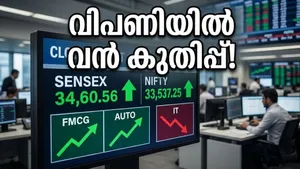 വിപണിയിൽ കാളക്കൂറ്റന്മാരുടെ തിരിച്ചുവരവ്; നിഫ്റ്റിയും സെൻസെക്സും കുതിച്ചുയർന്നത് എങ്ങനെ?
 -
 വിപണിയിൽ വൻ കുതിപ്പിന് കളമൊരുങ്ങുന്നു; ഈ ഓഹരികൾ ശ്രദ്ധിക്കാതെ പോകരുത്!
 -
 തിങ്കളാഴ്ച വിപണിയിൽ എന്ത് സംഭവിക്കും? നിക്ഷേപകരെ കാത്തിരിക്കുന്നത് വൻ അട്ടിമറികളോ?
-
Block for 8 hours
-
Block for 12 hours
-
Block for 24 hours
-
Don't block

 Sign in with Google
- Male
- Female
- Others
- Under 18
- 18 to 25
- 26 to 35
- 36 to 45
- 45 to 55
- 55+