
 A Oneindia Venture


 Click it and Unblock the Notifications
Notes to Accounts of Newtime Infrastructure Ltd.
Mar 31, 2025
2.9 Provisions
A provision is recognized if, as a result of a past event, the Company has a present legal or constructive
obligation that is reasonably estimated, and it is probable that an outflow of economic benefits will be
required to settle the obligation. Provisions determined by discounting the expected future cash flow at a
pre-tax rate that reflects current market assessment of the time value of money and the risk specified to
the liability.
2.10 Revenue recognition
Revenue is measured at the fair value of the consideration received or receivables. Amounts disclosed as
revenue are exclusive of taxes and net of returns, trade allowances, rebates, discounts and value added
taxes.
Revenue is recognized to the extent that it is probable that the economic benefits will flow to the company
and the revenue can be reliably measured regardless of when the payment is being made. The Company
bases its estimates on historical results, taking into consideration the type of customer, the type of
transaction and the specifics of each agreement.
⢠All expenses and income are accounted on accrual basis.
2.11 Fair Value Measurement
Fair value is the price that would be received to sell an asset or paid to transfer a liability in an orderly
transaction between market participants at the measurement date. The fair value measurement is based
on the presumption that the transaction to sell the asset or transfer the liability takes place either:
In the principal market for the asset or liability, or in the absence of a principal market, in the most
advantageous market for the asset or liability.
The principal or the most advantageous market must be accessible by the Group.
The fair value of an asset or a liability is measured using the assumptions that market participants would
use when pricing the asset or liability, assuming that market participants act in their economic best
interest.
A fair value measurement of a non-financial asset takes into account a market participant''s ability to
generate economic benefits by using the asset in its highest and best use or by selling it to another market
participant that would use the asset in its highest and best use.
The Group uses valuation techniques that are appropriate in the circumstances and for which sufficient
data are available to measure fair value, maximizing the use of relevant observable inputs and minimizing
the use of unobservable inputs.
All assets and liabilities for which fair value is measured or disclosed in the Consolidated financial
statements are categorized within the fair value hierarchy, described as follows, based on the lowest level
input that is significant to the fair value measurement as a whole:
Level 1 â Quoted (unadjusted) market prices in active markets for identical assets or liabilities
Level 2 â Valuation techniques for which the lowest level input that is significant to the fair value
measurement is directly or indirectly observable
Level 3 â Valuation techniques for which the lowest level input that is significant to the fair value
measurement is Unobservable
For assets and liabilities that are recognized in the Consolidated financial statements on a recurring basis,
the Group determines whether transfers have occurred between levels in the hierarchy by re-assessing
categorization (based on the lowest level input that is significant to the fair value measurement as a whole)
at the end of each reporting period or each case.
For the purpose of fair value disclosures, the Group has determined classes of assets and liabilities on the
basis of the nature, characteristics and risks of the asset or liability and the level of the fair value hierarchy
as explained above.
This note summarizes accounting policy for fair value. Other fair value related disclosures are given in the
relevant notes.
* Disclosures for valuation methods, significant estimates and assumptions
* Quantitative disclosures of fair value measurement hierarchy
* Investment in unquoted equity shares
* Financial instruments
2.12 Depreciation & amortization
The company depreciates property, plant and equipment over their estimated useful lives using the
straight-line method. Depreciation on additions/deductions to property, plant and equipment is provided
on pro-rata basis from the date of actual installation or up to the date of such sale or disposal, as the case
may be.
2.13 Earnings per equity share
Basic earnings per equity share is computed by dividing the net profit attributable to the equity holders of
the company by the weighted average number of equity shares outstanding during the period. Diluted
earnings per equity share is computed by dividing the net profit attributable to the equity holders of the
company by the weighted average number of equity shares considered for deriving basic earnings per
equity share and also the weighted average number of equity shares that could have been issued upon
conversion of all dilutive potential equity shares. The dilutive potential equity shares are adjusted for the
proceeds receivable had the equity shares been actually issued at fair value (i.e. the average market value
of the outstanding equity shares). Dilutive potential equity shares are deemed converted as of the
beginning of the period, unless issued at a later date. Dilutive potential equity shares are determined
independently for each period presented. The number of equity shares and potentially dilutive equity
shares are adjusted retrospectively for all periods presented for any share splits and bonus shares issues
including for changes effected prior to the approval of the financial statements by the Board of Directors.
2.14 Cash and Cash Equivalent
Cash and Cash equivalent comprise cash in hand and demand deposits, together with other short term,
highly liquid investment that are readily convertible into known amounts of cash and which are subject to
an in significant risk of changes in value.
2.15 Employee Benefit Expenses
Short-Term Employee Benefits
Short - term employee benefits include performance incentive, salaries & wages, bonus and leave travel
allowance. The undiscounted amount of short-term employee benefits expected to be paid in exchange for
the services rendered by employees are recognized during the year when the employees render the
services.
Long - Term Employee Benefits
The liability for gratuity & leave encashment is determined using Projected Unit Credit [PUC] Method and
is accounted for on the basis of actuarial valuation in Accordance with IND AS - 19. The company
recognizes the net obligation of a defined benefit plan in its balance sheet as an asset or liability. Actuarial
Gains and losses through re-measurements of the net defined benefit liability/ (asset) are recognized in
other comprehensive income. The current service cost is included in the employee benefit expense in the
statement of profit & loss account. The interest cost calculated by applying the discount rate to the net
balance of defined benefit obligation, is included in the finance cost in the statement of profit & loss
account.
2.16 Assets Held for Sale
Non-current assets or disposal group are classified as held for sale if their carrying amount will be
recovered principally through a sale transaction rather than through continuing use. This condition is
regarded as met.
2.17 Cash Flow Statement
Cash flow are reported using indirect method set out in Ind AS-7 on cash flow statement, expect in case of
dividend which is considered on the basis of actual movement of cash with corresponding adjustments of
assets and liabilities and where by profit for the period is adjusted for the effects of transactions of non¬
cash nature, any deferrals or accruals of past or future operating cash receipts or payments and items in
income or expenses associated with investing or financial cash flow. The cash flow from operating,
investing and financing activities of the company are segregated.
(ii) Terms / Rights attached to the Preference Shares:
The Company currently has issued 1% & 10% non cumulative redeemable preference shares having a par value of
Rs.10/- each. Preference shares will be redeemable after 18 years from the date of allotment at such premium as may be
decided by the board of director, subject to issue price.2
The shareholders of the Company, at their Extraordinary General Meeting (EGM) held on 27 February 2025, approved
the variation in the terms and rights attached to 39,44,960 10% Non-Convertible Non-Cumulative Redeemable
Preference Shares (RNCPS).
As per the approved variation, 39,44,960 (Thirty-Nine Lakh Forty-Four Thousand Nine Hundred Sixty) 10% Non¬
Convertible Non-Cumulative Redeemable Preference Shares shall be converted into 2,35,50,530 (Two Crore Thirty-Five
Lakh Fifty Thousand Five Hundred Thirty) 10% Compulsorily Convertible Preference Shares (CCPS) of face value ^10/-
(Rupees Ten only) each.
These CCPS will be compulsorily converted into equity shares of the Company at a price of ^9.50/- (Rupees Nine and
Fifty Paisa only) per share (including a premium of ^8.50/- per share) ("Conversion Price"), at any time after the date of
allotment and on or before the expiry of 18 (Eighteen) months from such allotment date.
The Company is in the process of obtaining the necessary regulatory and statutory approvals in connection with the
aforesaid conversion.
14.7 : Source of bonus shares issued: The company issued bonus shares from its security premium account.
1Shown under the heads Equity component of compound financial instrumentsin in note no. 15 and Borrowings in note
no. 16 in terms of IND AS.
3Board of Directors of the Company in their meeting on 11 April 2024, had proposed for issue of bonus shares to the
shareholders in the ratio of 2 new fully paid-up equity share of 1/- each for every 1 fully paid-up equity shares of 1/-. This
proposal was approved by shareholders in an extraordinary general meeting on May 8, 2024, with a record date of May
Fair value hierarchy
The fair value hierarchy is based on inputs to valuation techniques that are used to measure fair value that are either
observable or unobservable and consists of the following three levels:
Level 1 â Inputs are quoted prices (unadjusted) in active markets for identical assets or liabilities
Level 2 â Inputs are other than quoted prices included within Level 1 that are observable for the asset or liability, either
directly (i.e. as prices) or indirectly (i.e. derived from prices).
Level 3 â Inputs are not based on observable market data (unobservable inputs). Fair values are determined in whole or
in part using a valuation model based on assumptions that are neither supported by prices from observable current
market transactions in the same instrument nor are they based on available market data.
The management assessed that cash and cash equivalents, trade payables and other current liabilities approximate their
carrying amounts largely due to the short-term maturities of these instruments
The Company is exposed to credit risk and liquidity risk. The Company''s senior management overseas the Management
of these risks. The Board of Directors reviews and agrees policies for managing each risk, which are summarised as
below:
(A) Market risk:
Market risk is the risk that the fair value of future cash flows of a financial instrument will fluctuate because of
changes in market prices. Market risk comprises two types of risk: Interest rate risk and currency risk. Financial
instruments affected by market risk include loans and borrowings, deposits and payables/ receivables in foreign
currencies.
-Interest rate risk
Interest rate risk is the risk that the fair value or future cash flows of a financial instrument will fluctuate because of
changes in market interest rates. The Company has no such borrowings that carry fluctuating rate of interest and
hence, not exposed to interest rate risk.
- Foreign currency risks
Foreign risk is the risk that the fair value of future cash flows of an exposure will fluctuate because of changes in
foreign exchange rates. The Company is not dealing in foreign currency transaction therefore the Company is not
exposed to foreign currency risks.
(B) Credit risk
Credit risk is the risk that counterparty will not meet its obligations under a financial instrument or customer
contract, leading to a financial loss. The Company''s major financial assets represent investment , advances, trade
receivables and balances with bank. The Company attempts to limit the credit risk by dealing with reputed banks
only and dealing with parties post adequate diligence.
(C) Liquidity risk
Liquidity risk refers to the risk that the Company cannot meet its financial obligations. The objective of liquidity risk
management is to maintain sufficient liquidity and ensure funds are available for use as per requirements. The
Company''s prime source of liquidity is cash and cash equivalents and the cash generated from operations. The
Company has no outstanding bank borrowings.
Note 35: During the previous year, the Company had issued 1,82,00,000 convertible equity warrants to certain non¬
promoter individuals/entities on a preferential basis at Rs. 21.78 each, aggregating to Rs. 3963.96 lacs. Each warrant is
convertible into one equity share. The Company received 25% of the total amount, Rs. 990.00 lacs, as application money
for all warrants. Furthermore, the Company received the remaining 75% (Rs.751.41 lacs) for 46,00,000 warrants and
issued 46,00,000 equity shares against those warrants.
Note 36 Other Statutory Information for the current financial year
Additional Regulatory Information pursuant to General Instructions for preparation of Balance Sheet as given in
Division I of Schedule III to the Companies Act, 2013, are given hereunder to the extent relevant and other than those
given elsewhere in any other notes to the Financial Statements.
a. The Company does not has any immovable property for verification of title deeds.
b. The Company does not have any Benami property, where any proceeding has been initiated or pending against the
Company for holding any Benami property.
c. The Company has not been declared as a wilful defaulter by any lender who has powers to declare a company as a
wilful defaulter at any time during the financial year or after the end of reporting period but before the date when
the financial statements are approved.
d. The Company does not have any transactions with struck-off companies
e. The Company does not have any charges or satisfaction which is yet to be registered with the Registrar of Companies
(ROC) beyond the statutory period.
f. The Company does not have layers prescribed under clause (87) of section 2 of the Companies Act 2013 read with
Companies (Restrictions on number of Layers) Rules, 2017.
g. The company has not advanced or loaned or invested funds to any other person(s) or entity(is), including foreign
entities(intermediaries), with the understanding that the intermediary shall;
(i) Directly or indirectly lend or invest in other persons or entities identified in any manner whatsoever by or on
behalf of the Company (Ultimate Beneficiaries), or
(ii) Provide any guarantee, security or the like to or on behalf of the Ultimate Beneficiaries.
h. The Company has not received any funds from any person(s) or entity(ies), including foreign entities (Funding
Party) with the understanding (whether recorded in writing or otherwise) that the Company shall;
(i) Directly or indirectly lend or invest in other persons or entities identified in any manner whatsoever by or on
behalf of the Funding Party (Ultimate beneficiaries), or
(ii) Provide any guarantee, security or the like to or on behalf of the Ultimate Beneficiaries.
i. The Company does not have any transactions which is not recorded in the books of account but has been
surrendered or disclosed as income during the year in the tax assessments under the Income Tax Act, 1961 ( such as,
search or survey or any other relevant provisions of the Income Tax Act, 1961)
j. The Company has not traded or invested in Crypto currency or Virtual Currency during the financial year.
Note 3 7 Figures of previous year have been rearranged / regrouped as and when necessary in terms of current year''s grouping.
As per our report of even date. For and on behalf of the Board of Directors
For Chatterjee & Chatterjee Newtime Infrastructure Limited
Chartered Accountants
ICAI Firm registration No. 001109C
Sd/- Sd/-
BD Gujrati Ajay Kumar Thakur
Partner Director
Membership No. 010878 DIN : 10799462 Sd/-
UDIN : 25010878BMOSDT6204 Rajiv KaPur
Sd/- Kanika Kapur
Place: New Delhi Jyoti Verma Director
Date : 30th May 2025 Company Secretary DIN : 07154667
Mar 31, 2024
13.3 : Terms / Rights attached to the equity shares
The Company currently has issued equity shares having a par value of Rs.1/- per share. Each shareholder is eligible to one vote per share held. The company declares and pays dividends in Indian rupees. The dividend, if proposed by the Board of Directors, is subject to the approval of the shareholders in the Annual General Meeting, expect in case of interim dividend. In the event of liquidation of the Company, the equity shareholders are eligible to receive the remaning assets of the Company , after distribution of all preferential payments. The distribution will be in proportion of the number of equity shares held by the shareholders.
Preference Shares:
The Company currently has issued 1% & 10% non cumulative redeemable preference shares having a par value of Rs.10/- each. Preference shares will be redeemable after 18 years from the date of allotment at such premium as may be decided by the board of director, subject to issue price.
Terms of Preference share
-Preference shares will be redeemable after 18 years from the date of allotment at such premium as may be
decided by the board of director, subject to issue price
-Equity component of preference shares has been shown in other equity.
âSubsequent to the year end, Board of Directors of the Company in their meeting on 11 April 2024, had proposed for issue of bonus shares to the shareholders in the ratio of 2 new fully paid-up equity share of 1/- each for every 1 fully paid-up equity shares of 1/-. This proposal was approved by shareholders in an extraordinary general meeting on May 8, 2024, with a record date of May 21,2024. Bonus shares were allotted in board meeting held on 24 May 2024. Accordingly, earnings per share (EPS) amounts for all the periods presented have been adjusted to this effect in accordance with âInd AS 33; Earnings per Share"
âDiluted EPS represents earning per share based on the total number of shares including the potential estimated number of shares to be issued against convertible equity warrants.
The Group has a defined benefit gratuity plan in India (unfunded). The Groupâs defined benefit gratuity plan is a final salary plan for employees.
The gratuity plan is governed by the Payment of Gratuity Act, 1972. Under the act, employee who has completed five years of service is entitled to specific benefit. The level of benefits provided depends on the memberâs length of service and salary at retirement age.
The following tables summarise the components of net benefit expense recognised in the statement of profit and loss and amounts recognised in the balance sheet for the respective plans:
The sensitivity analyses above have been determined based on a method that extrapolates the impact on defined benefit obligation as a result of reasonable changes in key assumptions occurring at the end of the reporting period. The sensitivity analyses are based on a change in a significant assumption, keeping all other assumptions constant. The sensitivity analyses may not be representative of an actual change in the defined benefit obligation as it is unlikely that changes in assumptions would occur in isolation from one another.
Carrying value of all financial assets and liabilities is approximately equal to the fair value maturity period for all liabilities.
Fair value hierarchy
The fair value hierarchy is based on inputs to valuation techniques that are used to measure fair value that are either observable or unobservable and consists of the following three levels:
Level 1 â Inputs are quoted prices (unadjusted) in active markets for identical assets or liabilities
Level 2 â Inputs are other than quoted prices included within Level 1 that are observable for the asset or liability,
either directly (i.e. as prices) or indirectly (i.e. derived from prices).
Level 3 â Inputs are not based on observable market data (unobservable inputs). Fair values are determined in whole or in part using a valuation model based on assumptions that are neither supported by prices from observable current market transactions in the same instrument nor are they based on available market data.
The management assessed that cash and cash equivalents, trade payables and other current liabilities approximate their carrying amounts largely due to the short-term maturities of these instruments
The Company is exposed to credit risk and liquidity risk. The Companyâs senior management overseas the Management of these risks. . The Board of Directors reviews and agrees policies for managing each risk, which are summarised as below:
(A) Market risk:
Market risk is the risk that the fair value of future cash flows of a financial instrument will fluctuate because of changes in market prices. Market risk comprises two types of risk: Interest rate risk and currency risk. Financial instruments affected by market risk include loans and borrowings, deposits and payables/ receivables in foreign currencies.
-Interest rate risk
Interest rate risk is the risk that the fair value or future cash flows of a financial instrument will fluctuate because of changes in market interest rates. The Company has no such borrowings that carry fluctuating rate of interest and hence, not exposed to interest rate risk.
- Foreign currency risks
Foreign risk is the risk that the fair value of future cash flows of an exposure will fluctuate because of changes in foreign exchange rates. The Company is not dealing in foreign currency transaction therefore the Company is not exposed to foreign currency risks.
(B) Credit risk
Credit risk is the risk that counterparty will not meet its obligations under a financial instrument or customer contract, leading to a financial loss. The Companyâs major financial assets represent investment with banks, NBFC, Trade receivables, loans and advances and other financial assets. The Company attempts to limit the credit risk by dealing with reputed banks only.
(C) Liquidity risk
Liquidity risk refers to the risk that the Company cannot meet its financial obligations. The objective of liquidity risk management is to maintain sufficient liquidity and ensure funds are available for use as per requirements. The Companyâs prime source of liquidity is cash and cash equivalents and the cash generated from operations. The Company has no outstanding bank borrowings.
Note-30. Capital management
For the purpose of the Companyâs capital management, capital includes issued equity capital, share premium and all other equity reserves attributable to the equity holders of the Company. The Company monitors capital using a gearing ratio, which is net debt divided by total capital plus net debt. The Company includes within net debt, interest bearing loans and borrowings less cash and cash equivalents.
Note 33: During the current quarter, the Company issued 1,82,00,000 convertible equity warrants to certain nonpromoter individuals/entities on a preferential basis at Rs. 21.78 each, aggregating to Rs. 3963.96 lacs. Each warrant is convertible into one equity share. The Company received 25% of the total amount, Rs. 990.00 lacs, as application money for all warrants. Furthermore, the Company received the remaining 75% (Rs.751.41 lacs) for 46,00,000 warrants and issued 46,00,000 equity shares against those warrants.
Note 34 Other Statutory Information for the current financial year
Additional Regulatory Information pursuant to General Instructions for preparation of Balance Sheet as given in Division I of Schedule III to the Companies Act, 2013, are given hereunder to the extent relevant and other than those given elsewhere in any other notes to the Financial Statements.
a. The Company does not has any immovable property for verification of title deeds.
b. The Company does not have any Benami property, where any proceeding has been initiated or pending
against the Company for holding any Benami property.
c. The Company has not been declared as a wilful defaulter by any lender who has powers to declare a company as a wilful defaulter at any time during the financial year or after the end of reporting period but before the date when the financial statements are approved.
d. The Company does not have any transactions with struck-off companies
e. The Company does not have any charges or satisfaction which is yet to be registered with the Registrar
of Companies (ROC) beyond the statutory period.
f. The Company does not have layers prescribed under clause (87) of section 2 of the Companies Act 2013 read with Companies (Restrictions on number of Layers) Rules, 2017.
g. The company has not advanced or loaned or invested funds to any other person(s) or entity(is), including foreign entities(intermediaries), with the understanding that the intermediary shall;
(i) Directly or indirectly lend or invest in other persons or entities identified in any manner whatsoever by or on behalf of the Company (Ultimate Beneficiaries), or
(ii) Provide any guarantee, security or the like to or on behalf of the Ultimate Beneficiaries.
h. The Company has not received any funds from any person(s) or entity(ies), including foreign entities (Funding Party) with the understanding (whether recorded in writing or otherwise) that the Company shall;
(i) Directly or indirectly lend or invest in other persons or entities identified in any manner whatsoever by or on behalf of the Funding Party (Ultimate beneficiaries), or
(ii) Provide any guarantee, security or the like to or on behalf of the Ultimate Beneficiaries.
i. The Company does not have any transactions which is not recorded in the books of account but has been surrendered or disclosed as income during the year in the tax assessments under the Income Tax Act, 1961 ( such as, search or survey or any other relevant provisions of the Income Tax Act, 1961)
j. The Company has not traded or invested in Crypto currency or Virtual Currency during the financial year.
Note 35 Figures of previous year have been rearranged /regrouped as and when necessary in terms of current yearâs grouping.
Mar 31, 2023
Additional regulatory information required by schedule iii to the companies act, 2013
(i) The Company does not have any benami property held in its name. No proceedings have been initiated on or are pending against the Company for holding benami property under the Benami Transactions (Prohibition) Act, 1988 (45 of 1988) and Rules made thereunder.
(ii) The Company has not been declared wilful defaulter by any bank or financial institution or other lender or government or any government authority.
(iii) The Company has complied with the requirement with respect to number of layers as prescribed under section 2(87) of the Companies Act, 2013 read with the Companies (Restriction on number of layers) Rules, 2017.
(iv) Utilisation of borrowed funds and share premium
The Company has not advanced or loaned or invested funds to any other person(s) or entity(ies), including foreign entities (Intermediaries) with the understanding that the Intermediary shall:
(a) Directly or indirectly lend or invest in other persons or entities identified in any manner whatsoever by or on behalf of the Company (Ultimate Beneficiaries) or
(b) Provide any guarantee, security or the like to or on behalf of the ultimate beneficiaries.
The Company has complied with the requirement with respect to number of layers as prescribed under section 2(87) of the Companies Act, 2013 read with the Companies (Restriction on number of layers) Rules, 2017.
(a) directly or indirectly lend or invest in other persons or entities identified in any manner whatsoever by or on behalf of the Funding Party (Ultimate Beneficiaries) or
(b) provide any guarantee, security or the like on behalf of the ultimate beneficiaries
(v) There is no income surrendered or disclosed as income during the year in tax assessments under the Income Tax Act, 1961 (such as search or survey), that has not been recorded in the books of account.
(vi) The Company has not traded or invested in crypto currency or virtual currency during the year.
(vii) The Company does not have any charges or satisfaction of charges which is yet to be registered with Registrar of Companies beyond the statutory period.
(i) The Company has considered the possible impact of disruption caused by Covid-19 spread. Further, the Company will continue to monitor the future economic condition and its consequent impact on the business operations, given the nature of the pandemic.
(ii) Figures of previous year have been rearranged /regrouped as and when necessary in terms of current year''s grouping.
Jun 30, 2014
1. The directors of the Company have certified that the current
assets, Loans and Advance have a value on realization, at least equal
to the amount at which they are stated in the Balance Sheet as all
these accounts are in the ordinary course of Business & provisions of
all known liabilities have been accounted for in the regular books of
accounts.
2. Previous Year figure have been regrouped/rearranged wherever
necessary in order to make them comparable.
3. (a) Expenditure in Foreign Currency Nil
(b) Earning in Foreign Currency Nil
4. Notes 1 to 19 forms an integral part of the Balance Sheet and
Profit & Loss Account.
The company has only one class of equity shares having par value Of Rs.
1 per share. each holders of equity shares is entitled to one vote per
share and entitled to received the dividend.
NOTES 2.1
Revenue is recognised on accrual basis.
operating Income Includes income from service rendered.
Disclaimer: This is 3rd Party content/feed, viewers are requested to use their discretion and conduct proper diligence before investing, GoodReturns does not take any liability on the genuineness and correctness of the information in this article
More Information on Newtime Infrastructure Ltd.
-
Newtime Infrastructure Ltd. Tools
- Bulk Deals
- Block Deals
-
Newtime Infrastructure Ltd. Company Details
- Company Profile
- Company History
- Management Team
- Capital Structure
- Product Mix
- Banker/Auditor/Registrar
-
Company History
- Bonus
- BSE Price History
-
Newtime Infrastructure Ltd. Key Financial Ratios
- Ratios
-
Newtime Infrastructure Ltd. Results
- Quarterly Results
- Half Yearly Results
- Nine Months Results
- Annual Results
-
Newtime Infrastructure Ltd. Financial Data
- Audited Results
- Cash Flow
- Balance Sheet
-
Newtime Infrastructure Ltd. Reports
- Accounting Policies
- Auditors Report
- Directors Report
- Notes To Account
-
Newtime Infrastructure Ltd. Corporate Announcements
- Book Closure
- Board Meetings
- Change of Name
-
 ഓഹരി വിപണിയിൽ വൻ കുതിപ്പ്: സെൻസെക്സും നിഫ്റ്റിയും കുതിച്ചുയരുന്നു, നിക്ഷേപകർക്ക് വൻ നേട്ടം
 -
 വിപണിയിൽ വൻ ചാഞ്ചാട്ടം; ഐടി ഓഹരികളുടെ കുതിപ്പിനിടെ നിക്ഷേപകർ ഉറ്റുനോക്കുന്ന ആ നിർണ്ണായക തീരുമാനം ഇതാ!
 -
 കോൾ ഇന്ത്യ സെറ്റിൽമെന്റും വാഹന വിൽപന കണക്കുകളും; നിഫ്റ്റിയിൽ ഇന്ന് വൻ മാറ്റങ്ങൾക്ക് സാധ്യതയോ?
 -
 വെള്ളിയാഴ്ചത്തെ വിപണി തകർച്ച: നിക്ഷേപകരുടെ പണം ഒലിച്ചുപോയോ? സെൻസെക്സ് വീഴ്ചയ്ക്ക് പിന്നിലെ ഞെട്ടിക്കുന്ന കാരണങ്ങൾ ഇതാ!
 -
 സെൻസെക്സ് ഇടിവ് തുടരുമോ? തിങ്കളാഴ്ച വിപണിയിൽ വൻ മാറ്റങ്ങൾക്ക് സാധ്യത, നിക്ഷേപകർ ശ്രദ്ധിക്കേണ്ട കാര്യങ്ങൾ ഇതാ!
 -
 സെൻസെക്സും നിഫ്റ്റിയും കുതിക്കുന്നു; ഓഹരി വിപണിയിലെ ഈ വമ്പൻ മുന്നേറ്റത്തിന് പിന്നിലെ യഥാർത്ഥ കാരണം ഇതാണ്!
 -
 മൺസൂൺ കാറ്റിൽ വിപണി കുതിക്കുമോ? നിക്ഷേപകർ ശ്രദ്ധിക്കേണ്ട നിർണ്ണായക മാറ്റങ്ങളും ഐപിഒ അവസരങ്ങളും ഇതാ!
 -
 വിപണിയിൽ വൻ കുതിപ്പ്; സെൻസെക്സും നിഫ്റ്റിയും റെക്കോർഡ് ഉയരത്തിലേക്ക്, നിക്ഷേപകർക്ക് ഇനി എന്ത് സംഭവിക്കും?
 -
 ഓഹരി വിപണിയിൽ കടുത്ത ചാഞ്ചാട്ടം; നിക്ഷേപകർക്ക് ആശങ്കയോ അതോ അവസരമോ? സെൻസെക്സ് നൽകുന്ന സൂചനകൾ ഇതാ!
 -
 വിപണിയിൽ വൻ തകർച്ച; നിക്ഷേപകരെ ഞെട്ടിച്ച് സെൻസെക്സും നിഫ്റ്റിയും കൂപ്പുകുത്തിയതെങ്ങനെ?
 -
 വിപണിയിൽ തളർച്ച, പക്ഷേ ഓട്ടോ ഓഹരികളിൽ വൻ കുതിപ്പ്; നിക്ഷേപകർക്ക് ഇനി എന്ത് സംഭവിക്കും?
 -
 മെയ് 8: വിപണിയിൽ കുതിപ്പിന് സാധ്യതയോ? നിക്ഷേപകർ ശ്രദ്ധിക്കേണ്ട നിർണ്ണായക ഘടകങ്ങൾ ഇതാ!
 -
 വിപണിയിൽ കനത്ത ഇടിവ്; നിക്ഷേപകരെ ആശങ്കയിലാക്കി സെൻസെക്സും നിഫ്റ്റിയും കൂപ്പുകുത്തി
 -
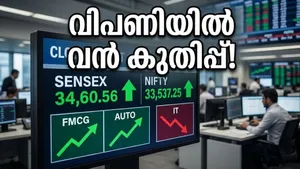 വിപണിയിൽ കാളക്കൂറ്റന്മാരുടെ തിരിച്ചുവരവ്; നിഫ്റ്റിയും സെൻസെക്സും കുതിച്ചുയർന്നത് എങ്ങനെ?
 -
 വിപണിയിൽ വൻ കുതിപ്പിന് കളമൊരുങ്ങുന്നു; ഈ ഓഹരികൾ ശ്രദ്ധിക്കാതെ പോകരുത്!
 -
 തിങ്കളാഴ്ച വിപണിയിൽ എന്ത് സംഭവിക്കും? നിക്ഷേപകരെ കാത്തിരിക്കുന്നത് വൻ അട്ടിമറികളോ?
-
Block for 8 hours
-
Block for 12 hours
-
Block for 24 hours
-
Don't block

 Sign in with Google
- Male
- Female
- Others
- Under 18
- 18 to 25
- 26 to 35
- 36 to 45
- 45 to 55
- 55+