
 A Oneindia Venture


 Click it and Unblock the Notifications
Notes to Accounts of Suraj Industries Ltd.
Mar 31, 2025
q. PROVISIONS, CONTINGENT LIABILITIES AND
CONTINGENT ASSETS
The assessments undertaken in recognising provisions and
contingencies have been made in accordance with applicable
Ind AS. Provisions, contingent liabilities, contingent assets
and commitments are reviewed at each balance sheet date
and are adjusted to reflect the current best estimate.
Provisions
Provisions represent liabilities to the Company for which
amount, or timing is uncertain. Provisions are recognized
when the Company has a present obligation (legal or
constructive), as a result of past events, and it is probable that
an outflow of resources, that can be reliably estimated, will
be required to settle such an obligation. If the effect of the
time value of money is material, provisions are determined
by discounting the expected future cash flows to net present
value using an appropriate pre-tax discount rate that reflects
current market assessments of the time value of money
and, where appropriate, the risks specific to the liability.
Unwinding of the discount is recognized in the statement of
profit and loss as a finance cost.
Contingent Liabilities
In normal course of business, contingent liabilities may arise
from litigation and other claims against the Company. There
are certain obligations which management of the Company
has concluded, based on all available facts and circumstances,
are not probable of payment or are very difficult to quantify
reliably, and such obligations are treated as contingent
liabilities and disclosed in the notes but are not reflected
as liabilities in the financial statements. Claims against the
Company, where the possibility of any outflow of resources
in settlement is remote, are not disclosed as contingent
liabilities. Show Cause Notices received are not treated as
Contingent Liabilities. Although there can be no assurance
regarding the final outcome of the legal proceedings in
which the Company is involved, it is not expected that such
contingencies will have a material effect on its financial
position or profitability.
Contingent Assets
Contingent assets are not recognised but disclosed in the
financial statements when an inflow of economic benefits is
probable.
r. CASH FLOW STATEMENT
Cash flows are reported using indirect method as set out in
Ind AS -7 "Statement of Cash Flows", whereby profit/ (loss)
before tax is adjusted for the effects of transactions of non¬
cash nature and any deferrals or accruals of past or future cash
receipts or payments. Cash flows from operating, investing
and financing activities of the Company are segregated based
on available information.
s. SEGMENT REPORTING
The company has two business segments- Edible Oil
Operations and Liquor Operations and segment-wise results,
assets and liabilities are accordingly given.
t. FAIR VALUE MEASUREMENT
The Company measures financial instruments at fair value at
each balance sheet date.
Fair value is the price that would be received to sell an
asset or paid to transfer a liability in an orderly transaction
between market participants at the measurement date. Fair
value measurement is based on presumption that transaction
to sell asset or transfer liability takes place either:
i. In the principal market for asset or liability, or
ii. In absence of a principal market, in most advantageous
market for asset or liability.
The principal or the most advantageous market must be
accessible to the Company. Fair Value of an asset or liability is
measured using assumptions that market participants would
use when pricing the asset or liability, assuming that market
participants act in their economic best interest.
A fair value measurement of a non-financial asset takes into
account a market participant''s ability to generate economic
benefits by using asset in its highest and best use or by selling
it to another market participant that would use asset in its
highest and best use.
The Company uses valuation techniques that are appropriate
in circumstances and for which sufficient data are available
to measure fair value, maximising use of relevant observable
inputs and minimizing use of unobservable inputs. All assets
and liabilities for which fair value is measured or disclosed in
the financial statements are categorized within the fair value
hierarchy, described as follows, based on the lowest level
input that is significant to the fair value measurement as a
whole.
Level 1- Quoted (unadjusted) market prices in active markets
for identical assets or liabilities.
Level 2- Valuation techniques for which lowest level input
that is significant to fair value measurement is directly or
indirectly observable.
Level 3- Valuation techniques for which lowest level input
that is significant to fair value measurement is unobservable.
For assets and liabilities that are recognised in the financial
statements on a recurring basis, the Company determines
whether transfers have occurred between levels in the
hierarchy by reassessing categorization (based on the lowest
level input that is significant to fair value measurement as a
whole) at end of each reporting period.
For the purpose of fair value disclosures, the Company has
determined classes of assets and liabilities on the basis of the
nature, characteristics and risks of the asset or liability and
the level of the fair value hierarchy as explained above.
u. EXCEPTIONAL ITEMS
Exceptional items are transactions which due to their
size or incidence are separately disclosed to enable a full
understanding of the Company''s financial performance.
Items which may be considered exceptional are significant
restructuring charges, gains or losses on disposal of
investments of subsidiaries, associate and joint ventures and
impairment losses/write down in the value of investment in
subsidiaries, associates and joint ventures and significant
disposal of fixed assets.
(A) The Company does not have any Benami property, where any proceeding has been initiated or pending against the Company
for holding any Benami property.
(B) The Company do not have any transactions with companies struck off under section 248 of the Companies Act, 2013.
(C) The Company do not have any charges or satisfaction which is yet to be registered with Registrar of Companies (ROC) beyond
the statutory period.
(D) The Company has not traded or invested in Crypto currency or Virtual Currency during the financial year.
(E) No funds have been advanced or loaned or invested (either from borrowed funds or share premium or any other sources
or kind of funds) by the Company to or in any other persons or entities, including foreign entities ("Intermediaries") with
the understanding, whether recorded in writing or otherwise, that the Intermediary shall lend or invest in other person or
entities ("ultimate beneficiaries") by or on behalf of the Company or provide any guarantee, security or the like to or on behalf
of the ultimate beneficiaries. The Company has not received any funds from any persons or entities, including foreign entities
("Funding Parties"), with the understanding that the Company shall lend or invest in other persons or entities identified by or
on behalf of the Funding Party or provide any guarantee, security or the like from to or on behalf of the Ultimate Beneficiaries.
(F) The Company has not entered into any such transaction which is not recorded in the books of accounts that has been
surrendered or disclosed as income during the year in the tax assessments under the Income Tax Act, 1961 (such as, search
or survey or any other relevant provisions of the Income Tax Act, 1961).
(G) The company does not have any borrowings from banks and financial institutions on the basis of security of current assets.
(H) The company has not been declared as wilful defaulter by any bank or financial institution or any other lender.
(I) The Company did not have any foreign exchange contracts including derivative contracts for which there were any material
foreseeable losses.
(J) There were no amounts which were required to be transferred to the Investor Education and Protection Fund by the
Company.
The Company measures financial instruments at fair value at each balance sheet date. Fair value is the price that would be received to
sell an asset or paid to transfer a liability in an orderly transaction between market participants at the measurement date. Fair value
measurement is based on presumption that transaction to sell asset or transfer liability takes place either:
i. In the principal market for asset or liability, or
ii. In absence of a principal market, in most advantageous market for asset or liability.
Fair Value of an asset or liability is measured using assumptions that market participants would use when pricing the asset or liability,
assuming that market participants act in their economic best interest. A fair value measurement of a non-financial asset takes into
account a market participant''s ability to generate economic benefits by using asset in its highest and best use or by selling it to another
market participant that would use asset in its highest and best use.
The Company uses valuation techniques that are appropriate in circumstances and for which sufficient data are available to measure
fair value, maximising use of relevant observable inputs and minimizing use of unobservable inputs.
All assets and liabilities for which fair value is measured or disclosed in the financial statements are categorized within the fair value
hierarchy, described as follows, based on the lowest level input that is significant to the fair value measurement as a whole.
Level 1- Quoted (unadjusted) market prices in active markets for identical assets or liabilities.
Level 2- Valuation techniques for which lowest level input that is significant to fair value measurement is directly or indirectly
observable.
Level 3- Valuation techniques for which lowest level input that is significant to fair value measurement is unobservable.
For assets and liabilities that are recognised in the financial statements on a recurring basis, the Company determines whether transfers
have occurred between levels in the hierarchy by re-assessing categorization (based on the lowest level input that is significant to fair
value measurement as a whole) at end of each reporting period. For the purpose of fair value disclosures, the Company has determined
classes of assets and liabilities on the basis of the nature, characteristics and risks of the asset or liability and the level of the fair value
hierarchy as explained above.
The Company''s overall risk management procedures to minimise potential adverse effects of financial market on the Company are as
follows:
(A) Market Risk
Market risk is attributable to all market risk sensitive financial instruments including investments and deposits, foreign
curreny receivables or payables. It includes three types of risks: a) Interest rate risk, b) Currency risk and c) price and
commodity risk.
A) Interest Rate Risk: The Companyâs borrowings are at fixed rates. Therefore, interest rate risk does not have any major
impact on the company.
B) Currency Risk: Since, Company does not have any foreign currency dealings, this risk is not applicable to the Company.
C) Price and commodity risk: The Company majorly purchases Spirits and Grain in its manufacturing. Since, prices are
generally regulated, there are no major movements in the prices. Therefore, the adversity of this risk is low.
(B) Credit Risk
Credit risk is the risk that counterparty will not meet its obligations under a financial intrument leading to a financial loss.
The Company''s exposure to credit risk primarily consists of Trade receivables and other financial assets. The Company deals
with only few customers since liquor opertions are government regulated. Therefore, default risk on the part of debtors is
significantly low.
(C) Liquidity Risk
The Company''s principle source of liquidity are Cash and cash equivalents and cash generated from operations. The Company
manages its liquidity risk in a manner so as to meet its normal financial obligations without any significant delay. The Company
has developed appropriate internal control systems and contingency plans for managing liquidity risk.
Note 49 CAPITAL MANAGEMENT (INR In lakhs)
(A) Risk Management
Capital management is driven by Company''s policy to maintain a sound capital base to support the continued development of its
business. The Management and Board of Directors seeks to maintain a prudent balance between different components of Company''s
capital. Management monitors capital structure and net financial debt at individual currency level. Net financial debt is defined as
current and non-current financial liabilities including lease liabilities less cash and cash equivalents and short term investments.
The capital structure is governed by policies approved by the Board of Directors and monitors capital using a gearing ratio, which is
net debt divided by total capital plus net debt. The Company includes within net debt, interest bearing loans and borrowings, trade and
other payables, lease liabilities, less cash and cash equivalents.
The accompanying notes are an integral part of the financial statements
As per our report of even date attached
For PAWAN SHUBHAM & CO. For and On behalf of the Board of Directors of
Chartered Accountants SURAJ INDUSTRIES LTD
Firm''s Registration No: 011573C
Sd/- Sd/- Sd/-
(CA Krishna Kumar) Suraj Prakash Gupta Ritesh Gupta
Partner (Managing Director) (Joint Managing Director)
Membership No. 523411 DIN-00243846 DIN- 00243741
Sd/- Sd/-
Somir Bhaduri Snehlata Sharma
Place: New Delhi Chief Financial Officer Company Secretary
Date: 27.05.2025 PAN No. AAXPB1836A M.No: 62066
Mar 31, 2024
q. PROVISIONS, CONTINGENT LIABILITIES AND CONTINGENT ASSETS
The assessments undertaken in recognising provisions and contingencies have been made in accordance with applicable Ind AS. Provisions, contingent liabilities, contingent assets and commitments are reviewed at each balance sheet date and are adjusted to reflect the current best estimate.
Provisions
Provisions represent liabilities to the Company for which amount, or timing is uncertain. Provisions are recognized when the Company has a present obligation (legal or constructive), as a result of past events, and it is probable that an outflow of resources, that can be reliably estimated, will be required to settle such an obligation. If the effect of the time value of money is material, provisions are determined by discounting the expected future cash flows to net present value using an appropriate pre-tax discount rate that reflects current market assessments of the time value of money and, where appropriate, the risks specific to the liability. Unwinding of the discount is recognized in the statement of profit and loss as a finance cost.
Contingent Liabilities
In normal course of business, contingent liabilities may arise from litigation and other claims against the Company. There are certain obligations which management of the Company has concluded, based on all available facts and circumstances, are not probable of payment or are very difficult to quantify reliably, and such obligations are treated as contingent liabilities and disclosed in the notes but are not reflected as liabilities in the financial statements. Claims against the Company, where the possibility of any outflow of resources in settlement is remote, are not disclosed as contingent liabilities. Show Cause Notices received are not treated as Contingent Liabilities. Although there can be no assurance regarding the final outcome of the legal proceedings in which the Company is involved, it is not expected that such contingencies will have a material effect on its financial position or profitability.
Contingent Assets
Contingent assets are not recognised but disclosed in the financial statements when an inflow of economic benefits is probable.
r. CASH FLOW STATEMENT
Cash flows are reported using indirect method as set out in Ind AS -7 âStatement of Cash Flowsâ, whereby profit/ (loss) before tax is adjusted for the effects of transactions of non-cash nature and any deferrals or accruals of past or future cash receipts or payments. Cash flows from operating, investing and financing activities of the Company are segregated based on available information.
s. SEGMENT REPORTING
The company has two business segments- Edible Oil Operations and Liquor Operations and segment-wise results, assets and liabilities are accordingly given.
t. FAIR VALUE MEASUREMENT
The Company measures financial instruments at fair value at each balance sheet date.
Fair value is the price that would be received to sell an asset or paid to transfer a liability in an orderly transaction between market participants at the measurement date. Fair value measurement is based on presumption that transaction to sell asset or transfer liability takes place either:
i. In the principal market for asset or liability, or
ii. In absence of a principal market, in most advantageous market for asset or liability.
The principal or the most advantageous market must be accessible to the Company. Fair Value of an asset or liability is measured using assumptions that market participants would use when pricing the asset or liability, assuming that market participants act in their economic best interest.
A fair value measurement of a non-financial asset takes into account a market participantâs ability to generate economic benefits by using asset in its highest and best use or by selling it to another market participant that would use asset in its highest and best use.
The Company uses valuation techniques that are appropriate in circumstances and for which sufficient data are available to measure fair value, maximising use of relevant observable inputs and minimizing use of unobservable inputs. All assets and liabilities for which fair value is measured or disclosed in the financial statements are categorized within the fair value hierarchy, described as follows, based on the lowest level input that is significant to the fair value measurement as a whole.
Level 1- Quoted (unadjusted) market prices in active markets for identical assets or liabilities. Level 2- Valuation techniques for which lowest level input that is significant to fair value measurement is directly or indirectly observable.
Level 3- Valuation techniques for which lowest level input that is significant to fair value measurement is unobservable.
For assets and liabilities that are recognised in the financial statements on a recurring basis, the Company determines whether transfers have occurred between levels in the hierarchy by reassessing categorization (based on the lowest level input that is significant to fair value measurement as a whole) at end of each reporting period.
For the purpose of fair value disclosures, the Company has determined classes of assets and liabilities on the basis of the nature, characteristics and risks of the asset or liability and the level of the fair value hierarchy as explained above.
u. EXCEPTIONAL ITEMS
Exceptional items are transactions which due to their size or incidence are separately disclosed to enable a full understanding of the Companyâs financial performance. Items which may be considered exceptional are significant restructuring charges, gains or losses on disposal of investments of subsidiaries, associate and joint ventures and impairment losses/write down in the value of investment in subsidiaries, associates and joint ventures and significant disposal of fixed assets.
Note 44 Additional Notes
(A) The Company does not have any Benami property, where any proceeding has been initiated or pending against the Company for holding any Benami property.
(B) The Company do not have any transactions with companies struck off under section 248 of the Companies Act, 2013.
(C) The Company do not have any charges or satisfaction which is yet to be registered with Registrar of Companies (ROC) beyond the statutory period.
(D) The Company has not traded or invested in Crypto currency or Virtual Currency during the financial year.
(E) No funds have been advanced or loaned or invested (either from borrowed funds or share premium or any other sources or kind of funds) by the Company to or in any other persons or entities, including foreign entities (âIntermediariesâ) with the understanding, whether recorded in writing or otherwise, that the Intermediary shall lend or invest in other person or entities ("ultimate beneficiaries") by or on behalf of the Company or provide any guarantee, security or the like to or on behalf of the ultimate beneficiaries. The Company has not received any funds from any persons or entities, including foreign entities ("Funding Parties"), with the understanding that the Company shall lend or invest in other persons or entities identified by or on behalf of the Funding Party or provide any guarantee, security or the like from to or on behalf of the Ultimate Beneficiaries.
(F) The Company has not entered into any such transaction which is not recorded in the books of accounts that has been surrendered or disclosed as income during the year in the tax assessments under the Income Tax Act, 1961 (such as, search or survey or any other relevant provisions of the Income Tax Act, 1961).
(G) The company does not have any borrowings from banks and financial institutions on the basis of security of current assets.
(H) The company has not been declared as wilful defaulter by any bank or financial institution or any other lender.
(I) The Company did not have any foreign exchange contracts including derivative contracts for which there were any material foreseeable losses.
(J) There were no amounts which were required to be transferred to the Investor Education and Protection Fund by the Company.
(K) Rule 11 (g) of Companies (Audit and Auditors) Rule, 2014 (âruleâ) stipulates that where the Company has used accounting software for maintaining its books of account, whether it has a feature of recording audit trail (edit log) facility and the same has been operated throughout the year for all transactions recorded in the software. The Company has used an accounting software for maintaining its books of accounts which has a feature of recording audit trail (edit log) facility and it operated throughout the year. However, management is not able to extract necessary control reports to determine whether the requirements of above rule has been met.
Note 47 Fair Value Measurements (INR in lakhs)
The Company measures financial instruments at fair value at each balance sheet date. Fair value is the price that would be received to sell an asset or paid to transfer a liability in an orderly transaction between market participants at the measurement date. Fair value measurement is based on presumption that transaction to sell asset or transfer liability takes place either:
i. In the principal market for asset or liability, or
ii. In absence of a principal market, in most advantageous market for asset or liability.
Fair Value of an asset or liability is measured using assumptions that market participants would use when pricing the asset or liability, assuming that market participants act in their economic best interest. A fair value measurement of a non-financial asset takes into account a market participantâs ability to generate economic benefits by using asset in its highest and best use or by selling it to another market participant that would use asset in its highest and best use.
The Company uses valuation techniques that are appropriate in circumstances and for which sufficient data are available to measure fair value, maximising use of relevant observable inputs and minimizing use of unobservable inputs.
All assets and liabilities for which fair value is measured or disclosed in the financial statements are categorized within the fair value hierarchy, described as follows, based on the lowest level input that is significant to the fair value measurement as a whole.
Level 1- Quoted (unadjusted) market prices in active markets for identical assets or liabilities. Level 2- Valuation techniques for which lowest level input that is significant to fair value measurement is directly or indirectly observable.
Level 3- Valuation techniques for which lowest level input that is significant to fair value measurement is unobservable.
For assets and liabilities that are recognised in the financial statements on a recurring basis, the Company determines whether transfers have occurred between levels in the hierarchy by re assessing categorization (based on the lowest level input that is significant to fair value measurement as a whole) at end of each reporting period. For the purpose of fair value disclosures, the Company has determined classes of assets and liabilities on the basis of the nature, characteristics and risks of the asset or liability and the level of the fair value hierarchy as explained above.
Note 48 FINANCIAL RISK MANAGEMENT OBJECTIVES AND POLICIES
(INR in lakhs)
The Companyâs Corporate Treasury function provides services to the business, co-ordinates access to domestic market risk (including currency risk, interest rate risk and other price risk), credit risk and liquidity risk. The company does not have foreign trade transactions nor any foreign currency transactions. The Board of Directors manages the financial risk of the company through internal risk reports and analyse exposure by magnitude of risk.
The Company''s overall risk management procedures to minimise potential adverse effects of financial market on the Company are as follows:
(A) Market Risk
Market risk is attributable to all the market risk sensitive financial instruments including investments and deposits, foreign currency receivables or payables. It includes three types of risks :a) Interest rate risk b) Currency risk and c) price and commodity risk.
A) Interest Rate Risk: The Companyâs borrowing are at fixed rates.Therefore,interest rate risk does not have any major impact on the company.
B) Currency Risk: Since, Company does not have any foreign currency dealings, this risk is not applicable to the Company.
C) Price and commodity risk: The Company majorly purchase Spirits and Grain in its
manufacturing . Since , prices are generally regulated, there are no major movements in the prices .Therefore, the adversity of this risk is low.
(B) Credit Risk
Credit Risk is the risk that counterparty will not meet its obligations under a financial instrument leading to a financial loss.The Companyâs exposure to credit risk primarily consists of trade receivables and other financial assets . The Company deals with only few customers since liquor operations are government regulated . Therefore, default risk on the part of debtors is significantly low.
(C) Liquidity Risk
The Companyâs principle source of liquidity are Cash and cash equivalents and cash generated from operations . The Company manages its liquidity risk in a manner so as to meet its normal financial obligations without any significant delay. The Company has developed appropriate internal control systems and contingency plans for managing liquidity risk.
Note 49 CAPITAL MANAGEMENT (INR in lakhs)
(A) Risk Management
Capital management is driven by Company''s policy to maintain a sound capital base to support the continued development of its business. The Management and Board of Directors seeks to maintain a prudent balance between different components of Company''s capital. Management monitors capital structure and net financial debt at individual currency level. Net financial debt is defined as current and non-current financial liabilities including lease liabilities less cash and cash equivalents and short term investments.
The capital structure is governed by policies approved by the Board of Directors and monitors capital using a gearing ratio, which is net debt divided by total capital plus net debt. The Company includes within net debt, interest bearing loans and borrowings, trade and other payables, lease liabilities, less cash and cash equivalents.
Note 51 Previous yearâs figures have been regrouped/reclassified, wherever considered necessary As per our Report of even date
For PAWAN SHUBHAM & CO. For and On behalf of the Board of Directors of
Chartered Accountants SURAJ INDUSTRIES LTD
Firmâs Registration No: 011573C
Sd/- Sd/- Sd/-
(CA Krishna Kumar) Suraj Prakash Gupta Syed Azizur Rahman
PARTNER (Managing Director) (Non- Executive Director)
Membership No. 523411 DIN-00243846 DIN- 00242790
Sd/- Sd/-
Somir Bhaduri Snehlata Sharma
Place: New Delhi Chief Financial Officer Company Secretary
Date: 28.05.2024 PAN No.AAXPB1836A M.No: 62066
Mar 31, 2015
1. c) The Company has only one class of equity shares having par value of
Rs. 10 per share. Each holder of equity shares is entitled to one vote
per share and has a right to receive dividend as recommended by the
board of directors subject to the necessary approval from the
shareholders.
In the event of liquidation of the Company, the holders of equity
shares will be entitled to receive remaining assets of the Company,
after distribution of all preferential amounts. The distribution will
be in proportion to the paid up amount per equity shares held by the
shareholders.
2. In the opinion of the board, the current assets, loans &
advances have a value on realisation in the ordinary course of business
at least equal to the amount at which these are stated in the balance
sheet as at 31.03.2015.
3. The balances of some of the Sundry Creditors, Loans & Advances
are subject to letters of confirmations without expecting any major
deviations to affect materiality of these accounts.
4. Upto the end of the previous reporting periods, the Company had
two business segments viz. (i) Manufacturing of Vanaspati; (ii) Liquor,
identified as discontinued operations. During the previous year, the
discontinued operations were completed and the remaining assets or
liabilities which continue after the discontinued operations are
completed, have been eliminated from the disclosures of Discontinued
operations. After the completion of said discontinued operations were
completed, the company has not yet commenced any new sustainable
business activity and therefore these accounts have been prepared on
the same basis without following the going concern assumption as in the
previous years. In view of these facts, the company has not identified
any seperate business segment for its review and disclosures. The
intermittent trading operations, if any, which may be non-recurring and
casual in nature, has not been considered as a separate business
segment for the purpose of reviewing its operations.
5. The company has a defined benefit gratuity plan & leave
encashment as long term benefits to employees. In view of the limited
number of employees left on discontinued operations of the company, the
actuarial valuation has not been carried out during the year for such
long term benefits. However, in compliance of AS-15, a reasonable
estimate of company's liability towards such long term benefits to all
the employees, has been made on the presumption as if all are retiring
on the balance sheet date.
6. There are no amount due to small scale Industrial undertaking
suppliers,covered under Micro, Small and Medium Enterprises Development
Act, 2006.
7. RELATED PARTY DISCLOSURE
The information given below is only in respect of the transactions
entered into by the company or any outstanding, during the year with
the related parties.
A) Names of the Related parties and description of relationship Key
Managerial Personnel
a) J K Jain, Director
b) Shashi Sharma, Director
c) Pradeep Gupta, Director(Upto 14.11.2014)
d) Narendra Singh Bisht, Director(w.e.f 14.11.2014)
B) Transactions during the year with the Related Parties:
8. Deferred Tax:
Major components of Deferred Tax Asset (net) arising on account of
timing difference are as under:
9. PROVISION FOR INCOME TAX
The provision for the current Income Tax is not considered necessary
for the financial year 2014-2015 in view of the brought forward
business loss, unabsorbed depreciation allowance, other deductions and
benefits under the provisions of Income Tax Act, 1961.
10. Expenditure in Foreign Currency during the year- Nil (Previous
Year Nil)
12. Value of Imports on CIF Basis- Nil (Previous Year Nil)
13. Value of imported and indigenous raw materials, stores, spare
parts and components consumed -Nil Note 24 BASIC AND DILUTED EARNING
PER SHARE
14. The previous year's figures have been re-classified/re-grouped
wherever required to conform with the current year's figures.
Mar 31, 2010
1. Stock invest pertaining to Share application money for 10,300
equity Shares (Previous year 10,300 equity shares) of Rs. 10/- each
were returned unrealized by the Bankers and the same were allotted and
included in Share Capital during the financial year 1993-94 as part of
Companys maiden public issue. Out of these shares, the company has to
still receive a sum of Rs. 99,000 as on 31.03.2010 as per details given
below:
à On 9,500 Shares @ Rs. 10/- each amounting to Rs. 95,000
à On 800 Shares @ Rs. 5/- each (Rs. 5/- each paid on allotment)
amounting to Rs. 4,000
2. In the opinion of the board, the current assets, loans & advances
have a value on realisation in the ordinary course of business at least
equal to the amount at which these are stated in the balance sheet as
at 31.03.2010.
3. Some of the balances of Sundry Creditors, Loans & Advances are
subject to letters of confirmations without expecting any major
deviations to affect materiality of these accounts.
4. The Company has been reviewing its operations till 31.08.2007, under
two business segments viz. (i) Manufacturing of Vanaspati; (ii) Liquor,
B) The amount of revenue and expenses and amount of pre-tax profit or
loss in respect of the ordinary activities as attributable to the
discontinuing operations during the current financial reporting period
and amount of income tax expense, if any, is appropriately disclosed in
the profit & loss account.
C) The intermittent trading operations are considered as a separate
business segment for review purposes.
7. Additional Information required pursuant to the Provisions of
paragraph 3 & 4 of Part 2 of schedule VI to the Companies Act 1956 are
not disclosed in view of suspended and discontinued manufacturing
operations by the company in earlier years.
8. The company has a defined benefit gratuity plan & leave encashment
as long term benefits to employees. In view of the limited number of
employees left on discontinued operations of the company, the actuarial
valuation has not been carried out during the year for such long term
benefits. However, in compliance of AS-15, a reasonable estimate of
companys liability towards such long term benefits to all the
employees, has been made on the presumption as if all are retiring on
the balance sheet date.
9. a) Small Scale Industrial Undertakings to whom amounts are due have
been determined based on the information available with the company,
included in creditors.
b) The Company has not received the required information from Suppliers
regarding their status under Micro, Small and Medium Enterprises
Development Act, 2006. Hence disclosures, if any, relating to amounts
unpaid as at the year end together with interest paid/ payable as
required under the said Act have not been made.
10. With the Discontinuing operations in the identified business
segments of Vanaspati and Liquor and involving limited transactions,
the segment wise results have not been considered relevant and hence
not disclosed. The intermittent trading operations has not been
considered as a separate business segment for the purpose of reviewing
its operations.
11. Related Party Disclosures
a) Names of Related Parties and description of Relationship, with whom
transactions have taken place
during the year:
i) Key Managerial Personnel:
Mr. Gupta à Whole Time Director
14. Expenditure in Foreign Currency (Rs in Lacs)
à Travelling Expenses Nil (Previous Year Nil)
15. Earnings in Foreign Currency Nil (Previous Year Nil)
16. Previous year figures have been regrouped/restated wherever
considered necessary to conform with current year figures.
17. Companys abstract and business profile pursuant to part IV of
schedule VI is separately enclosed herewith.
Disclaimer: This is 3rd Party content/feed, viewers are requested to use their discretion and conduct proper diligence before investing, GoodReturns does not take any liability on the genuineness and correctness of the information in this article
More Information on Suraj Industries Ltd.
-
Suraj Industries Ltd. Tools
- Bulk Deals
-
Suraj Industries Ltd. Company Details
- Company Profile
- Company History
- Management Team
- Capital Structure
- Product Mix
- Banker/Auditor/Registrar
-
Company History
- Rights
- BSE Price History
-
Suraj Industries Ltd. Key Financial Ratios
- Ratios
-
Suraj Industries Ltd. Results
- Quarterly Results
- Half Yearly Results
- Nine Months Results
- Annual Results
-
Suraj Industries Ltd. Financial Data
- Audited Results
- Cash Flow
- Balance Sheet
-
Suraj Industries Ltd. Reports
- Accounting Policies
- Auditors Report
- Directors Report
- Notes To Account
-
Suraj Industries Ltd. Corporate Announcements
- Book Closure
- Dividend
- Board Meetings
-
 ഓഹരി വിപണിയിൽ വൻ കുതിപ്പ്: സെൻസെക്സും നിഫ്റ്റിയും കുതിച്ചുയരുന്നു, നിക്ഷേപകർക്ക് വൻ നേട്ടം
 -
 വിപണിയിൽ വൻ ചാഞ്ചാട്ടം; ഐടി ഓഹരികളുടെ കുതിപ്പിനിടെ നിക്ഷേപകർ ഉറ്റുനോക്കുന്ന ആ നിർണ്ണായക തീരുമാനം ഇതാ!
 -
 കോൾ ഇന്ത്യ സെറ്റിൽമെന്റും വാഹന വിൽപന കണക്കുകളും; നിഫ്റ്റിയിൽ ഇന്ന് വൻ മാറ്റങ്ങൾക്ക് സാധ്യതയോ?
 -
 വെള്ളിയാഴ്ചത്തെ വിപണി തകർച്ച: നിക്ഷേപകരുടെ പണം ഒലിച്ചുപോയോ? സെൻസെക്സ് വീഴ്ചയ്ക്ക് പിന്നിലെ ഞെട്ടിക്കുന്ന കാരണങ്ങൾ ഇതാ!
 -
 സെൻസെക്സ് ഇടിവ് തുടരുമോ? തിങ്കളാഴ്ച വിപണിയിൽ വൻ മാറ്റങ്ങൾക്ക് സാധ്യത, നിക്ഷേപകർ ശ്രദ്ധിക്കേണ്ട കാര്യങ്ങൾ ഇതാ!
 -
 സെൻസെക്സും നിഫ്റ്റിയും കുതിക്കുന്നു; ഓഹരി വിപണിയിലെ ഈ വമ്പൻ മുന്നേറ്റത്തിന് പിന്നിലെ യഥാർത്ഥ കാരണം ഇതാണ്!
 -
 മൺസൂൺ കാറ്റിൽ വിപണി കുതിക്കുമോ? നിക്ഷേപകർ ശ്രദ്ധിക്കേണ്ട നിർണ്ണായക മാറ്റങ്ങളും ഐപിഒ അവസരങ്ങളും ഇതാ!
 -
 വിപണിയിൽ വൻ കുതിപ്പ്; സെൻസെക്സും നിഫ്റ്റിയും റെക്കോർഡ് ഉയരത്തിലേക്ക്, നിക്ഷേപകർക്ക് ഇനി എന്ത് സംഭവിക്കും?
 -
 ഓഹരി വിപണിയിൽ കടുത്ത ചാഞ്ചാട്ടം; നിക്ഷേപകർക്ക് ആശങ്കയോ അതോ അവസരമോ? സെൻസെക്സ് നൽകുന്ന സൂചനകൾ ഇതാ!
 -
 വിപണിയിൽ വൻ തകർച്ച; നിക്ഷേപകരെ ഞെട്ടിച്ച് സെൻസെക്സും നിഫ്റ്റിയും കൂപ്പുകുത്തിയതെങ്ങനെ?
 -
 വിപണിയിൽ തളർച്ച, പക്ഷേ ഓട്ടോ ഓഹരികളിൽ വൻ കുതിപ്പ്; നിക്ഷേപകർക്ക് ഇനി എന്ത് സംഭവിക്കും?
 -
 മെയ് 8: വിപണിയിൽ കുതിപ്പിന് സാധ്യതയോ? നിക്ഷേപകർ ശ്രദ്ധിക്കേണ്ട നിർണ്ണായക ഘടകങ്ങൾ ഇതാ!
 -
 വിപണിയിൽ കനത്ത ഇടിവ്; നിക്ഷേപകരെ ആശങ്കയിലാക്കി സെൻസെക്സും നിഫ്റ്റിയും കൂപ്പുകുത്തി
 -
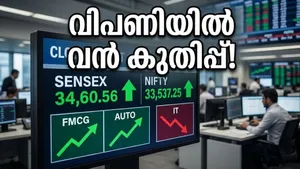 വിപണിയിൽ കാളക്കൂറ്റന്മാരുടെ തിരിച്ചുവരവ്; നിഫ്റ്റിയും സെൻസെക്സും കുതിച്ചുയർന്നത് എങ്ങനെ?
 -
 വിപണിയിൽ വൻ കുതിപ്പിന് കളമൊരുങ്ങുന്നു; ഈ ഓഹരികൾ ശ്രദ്ധിക്കാതെ പോകരുത്!
 -
 തിങ്കളാഴ്ച വിപണിയിൽ എന്ത് സംഭവിക്കും? നിക്ഷേപകരെ കാത്തിരിക്കുന്നത് വൻ അട്ടിമറികളോ?
-
Block for 8 hours
-
Block for 12 hours
-
Block for 24 hours
-
Don't block

 Sign in with Google
- Male
- Female
- Others
- Under 18
- 18 to 25
- 26 to 35
- 36 to 45
- 45 to 55
- 55+